
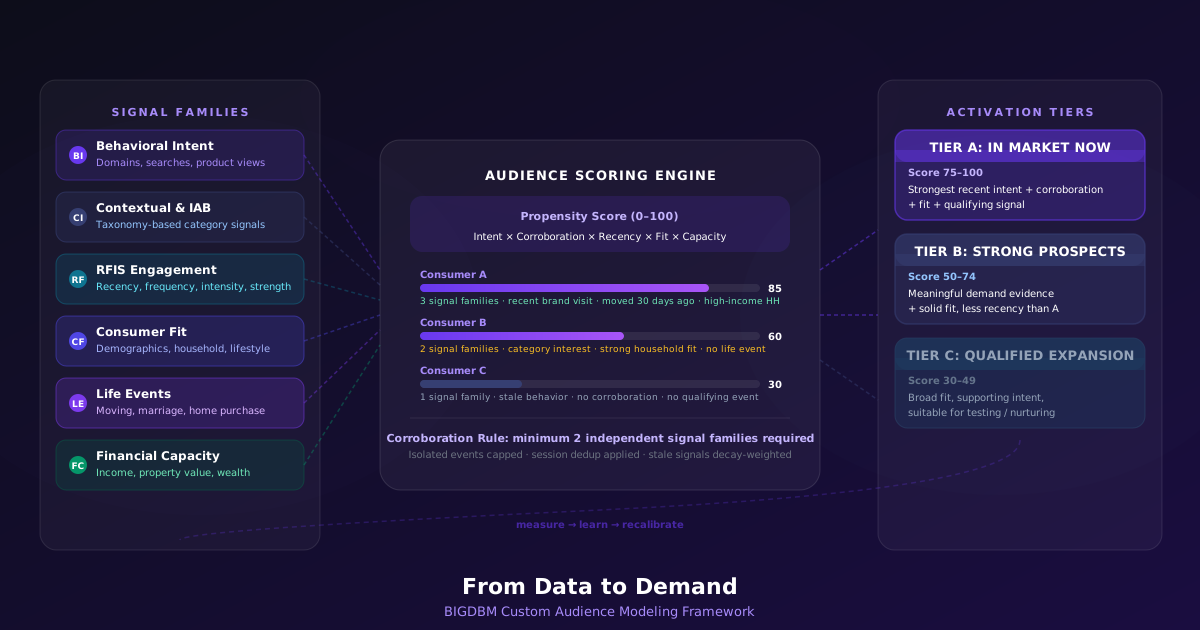
Having more data does not automatically create better audiences.
The real advantage comes from understanding what the data means in the context of a specific product, service, brand, and buying decision.
At BIGDBM, we approach audience modeling from that perspective. Instead of starting with a generic demographic profile and asking, "Who looks like this customer?", we start with a more important question:
What combination of behaviors, characteristics, circumstances, and signals would make someone more likely to need, want, consider, and ultimately purchase this specific product or service?
From there, BIGDBM data can be transformed into a purpose-built audience model that identifies, scores, and prioritizes consumers based on their potential relevance to the advertiser. The result is not simply an audience segment. It is a model of potential demand.
The Product Comes Before the Audience
One of the most important steps in building an audience model happens before any scoring begins. We first need to understand the product. That means understanding factors such as:
- What is being sold?
- What is the typical price point?
- Is the purchase discretionary or necessary?
- How frequently does someone purchase it?
- What events might cause someone to need it?
- What alternatives or competitors might they consider?
- What research usually happens before the purchase?
- What financial capacity may be required?
- What lifestyle characteristics make the product relevant?
- What behaviors indicate that someone may be moving from general interest toward active consideration?
These questions can produce dramatically different models even when two brands operate within the same broad industry. A premium furniture retailer, for example, should not simply target "people interested in furniture." Someone repeatedly researching premium sofas, visiting several high-end furniture brands, consuming interior-design content, recently purchasing a home, and living in a high-value property tells a much richer story.
Likewise, a fashion and lifestyle retailer should not simply target "women interested in clothing." Fashion categories, accessories, beauty interests, gifting behavior, life stage, household characteristics, shopping behavior, and recency can collectively provide a much stronger indication of potential customer fit.
The objective is not to find people who match a category. The objective is to recognize combinations of signals that make commercial sense for the specific product being marketed.
Turning BIGDBM Data Into Signals
Once the commercial problem is understood, we identify which BIGDBM data points can help describe the potential customer. Depending on the use case, these signals can come from several different data families.
Behavioral Intent
Behavior can provide some of the strongest evidence that a consumer is actively researching a category. Signals may include domains visited, pages and URLs, search activity, keywords, referral information, product or category interactions, and related digital behaviors.
But individual events should rarely be interpreted in isolation. Visiting one furniture-related page is very different from repeatedly researching dining tables, visiting multiple premium furniture brands, and searching for a specific design style. The model therefore considers not just what happened, but also the depth, diversity, persistence, and commercial relevance of that behavior.
Contextual and IAB Signals
BIGDBM can also use taxonomy-based signals to understand the broader context surrounding a consumer's activity. IAB categories can help distinguish between someone consuming generic content and someone demonstrating behavior associated with an in-market category.
For a furniture model, furniture, interior design, architecture, remodeling, moving, and new-homeownership categories may all contribute different amounts of evidence. For a fashion retailer, dresses, tops, handbags, jewelry, footwear, beauty, gifting, weddings, and lifestyle categories may collectively describe a very different consumer journey. The key is weighting those categories according to their relationship with the product. A signal that is extremely valuable for one model may be almost irrelevant to another.
Recency, Frequency, Intensity, and Strength
Behavior also has a time dimension. Someone who demonstrated relevant intent yesterday should generally be treated differently from someone who exhibited the same behavior six months ago. Similarly, repeated behavior across multiple days and categories may represent stronger intent than dozens of events generated during one browsing session.
This is why BIGDBM models incorporate an RFIS framework:
- Recency: How recently did the relevant behavior occur?
- Frequency: How consistently has the behavior appeared?
- Intensity: How much relevant activity has been observed?
- Strength: How meaningful is the overall pattern?
Together, these dimensions help separate occasional interest from persistent consideration.
Identity Resolution Changes the Unit of Analysis
Digital activity frequently begins with devices, browsers, IP addresses, hashed identifiers, or other signals. Advertising decisions, however, ultimately concern people and households.
BIGDBM's identity capabilities allow signals to be connected, where appropriate, to a resolved individual or household. This changes the analysis considerably. Instead of asking, "What did this device do?", we can begin asking, "What combination of relevant signals have we observed around this consumer or household?"
Identity resolution enables us to unify signals and suppress duplicates, creating the foundation for combining behavioral evidence with other relevant attributes rather than treating each touch point in isolation.
Adding Consumer and Household Context
Behavior tells us what someone appears to be interested in. Other BIGDBM data can help determine whether the surrounding consumer context makes that behavior more meaningful.
Depending on the model, useful attributes might include household income, age ranges, household composition, homeownership, property characteristics, home value, estimated net worth, lifestyle indicators, purchase role, or other relevant characteristics. The importance of each attribute depends entirely on the product.
For an expensive home furnishing purchase, property value and purchasing capacity may be relevant supporting signals. For another product, those attributes may contribute little or nothing. This is why BIGDBM models are not built from a universal scoring template. The product determines which data matters.
Life Events Can Explain Why Someone Is Entering the Market
Some purchases are strongly connected to changes in a consumer's life:
- Moving or buying a home
- Remodeling or renovating
- Getting married or starting a family
- Sending children to college
- Changing jobs or entering retirement
These events can dramatically alter purchasing behavior. A consumer researching furniture shortly after moving into a new home may represent a different opportunity than someone casually reading interior-design content. Likewise, wedding-related activity can create demand across apparel, jewelry, gifts, travel, home products, financial products, and many other categories.
The important modeling question becomes: what events create or accelerate demand for this particular product? Those events can then become part of the scoring architecture.
Build Signal Families, Not Giant Lists of Attributes
One of the most useful ways to structure these models is to organize data into logical signal families. Each family answers a different question. Instead of allowing one isolated attribute to determine whether someone belongs in an audience, the model evaluates the combined evidence.
Commercial Intent
Direct brand engagement, product research, searches, and competitor activity.
Category Intent
Behavior associated with relevant products, services, or adjacent categories.
Contextual Interest
Content and IAB categories that reinforce the consumer's broader interests.
Engagement Quality
Recency, frequency, intensity, and strength of observed behavior.
Consumer Fit
Demographic or household attributes relevant to the product and its buyer.
Financial Capacity
Income, property value, wealth, and other relevant capacity indicators.
Life Events
Events that create or accelerate a new purchase requirement.
Competitive Research
Interactions with alternative brands or solutions in the market.
Corroboration Is More Powerful Than a Single Signal
This is one of the most important concepts behind the methodology. Consider two consumers:
- Consumer A visits one furniture website 20 times.
- Consumer B visits three premium furniture brands, searches for a specific sofa style, reads interior-design content, and recently moved.
Consumer A generated more raw events. But Consumer B may represent the stronger commercial opportunity. This is why sophisticated audience models should reward independent corroborating signals rather than simply counting events.
A well-designed framework requires multiple independent signals and at least one recent qualifying signal before a consumer becomes eligible for the modeled audience. This prevents repetitive or accidental browsing behavior from dominating the model.
Separate Qualification From Prioritization
Another important modeling principle is recognizing that not every variable should simply add points. Some attributes are better used as qualification rules. Others are better suited to ranking.
Household and purchaser characteristics can establish baseline audience qualification, while behavioral signals are then used to prioritize consumers within the qualified population. Key household characteristics should not simply behave like ordinary additive points — behavioral evidence should determine prioritization among otherwise eligible households.
This distinction helps prevent misleading results. A consumer should not automatically become a top prospect simply because they are wealthy. Likewise, someone should not necessarily become a top prospect because they generated a large number of weak behavioral events. The strongest audiences emerge when eligibility and intent reinforce each other.
Build an Explainable 0–100 Propensity Score
Once the relevant signal families have been identified, they can be transformed into a scoring model. A common implementation is a normalized score from 0 to 100. But the important part is not the number itself. The important part is what contributes to it.
A conceptual model might look like:
Audience Score = Commercial Intent + Category Intent + Competitive Intent + Context + Engagement Quality + Consumer Fit + Life-Event Relevance + Financial Capacity
The weights change depending on the product. For a high-consideration purchase, active behavioral intent may dominate. For another business, household characteristics may matter more. For products strongly connected with life events, timing may become particularly important.
Two brands in the same industry can require entirely different scoring architectures. Same methodology, different commercial problem, different model.
Prevent Weak Signals From Creating Strong Prospects
A good scoring system also needs negative rules. Generic browsing, stale behavior, repeated events from the same session, low-quality traffic, irrelevant categories, bots, and other noisy signals can create misleading scores if they are allowed to accumulate freely.
Models therefore need caps, exclusions, deduplication rules, and eligibility requirements. For example, a consumer with a high estimated net worth and expensive home should not automatically qualify for a premium campaign without relevant behavioral or contextual evidence. Wealth alone is not intent.
This is an important distinction between data availability and data relevance. Just because an attribute exists does not mean it should materially influence the model.
Convert Scores Into Activation Tiers
The final score can then be translated into actionable audience tiers:
In Market Now
Consumers showing the strongest combination of recent intent, corroborating behavior, product relevance, and supporting characteristics. Highest activation priority.
Strong Prospects
Consumers with meaningful evidence of demand and strong overall fit, but less recency or fewer corroborating signals than Tier A.
Qualified Expansion
Consumers who fit the broader opportunity and demonstrate sufficient supporting intent to justify testing or nurturing campaigns.
The important point is that marketers are no longer forced to treat every record equally. They can decide how aggressively to activate based on modeled propensity.
The Model Should Explain Why Someone Scored Highly
A powerful audience model should never produce only a number. It should be possible to understand the evidence behind that score.
- Strong recent product intent observed
- Multiple relevant competitor interactions
- High RFIS engagement quality score
- Qualifying life-event signal present
- Strong household and product fit
- Three independent signal families observed
This explainability is valuable for marketers, analysts, optimization teams, and model governance. The score becomes more than an opaque prediction. It becomes a compressed representation of the evidence behind the prediction. Retaining component scores, timestamps, evidence counts, qualifying intent dates, signal-family counts, top categories, and top intent terms alongside the final score makes the model auditable and improvable.
From Heuristic Model to Learning System
The first version of an audience model represents a hypothesis. It combines domain expertise, understanding of the product, BIGDBM data, behavioral evidence, and logical assumptions about the customer journey. But the model should not remain static.
Once campaigns begin generating outcomes, those outcomes can be used to determine which signals actually predict performance:
- Did the highest-scoring consumers convert more frequently?
- Did recent competitor behavior matter more than expected?
- Did certain IAB categories produce little incremental value?
- Did a particular life event dramatically increase conversion probability?
- Did Tier A outperform Tier B enough to justify the narrower audience?
Evaluating results by score decile, tier, and component contribution — then recalibrating weights as conversion evidence accumulates — creates a feedback loop. Maintaining holdout populations allows incremental performance to be measured rather than assumed.
Over time, a carefully constructed heuristic model can evolve into an increasingly empirical prediction system.
Why Deep Product Understanding Matters
This entire process depends on something that cannot be solved simply by adding more rows to a database: understanding why people buy.
Consider two consumers with similar demographics. One may be researching a category because they are curious. The other may have experienced a life event, researched several competitors, searched for specific products, repeatedly returned to relevant content, and demonstrated the financial and household characteristics associated with the purchase.
Traditional segmentation may put them in the same audience. A properly constructed intent model should not. That is where BIGDBM's combination of data and modeling becomes particularly powerful. We can move beyond asking, "Who matches the customer profile?", and begin asking, "Who is exhibiting the combination of signals we would expect to see before someone becomes a customer?"
A General BIGDBM Modeling Framework
Across industries, the methodology can be summarized as a repeatable process:
- Understand the product and economics. Study the product, price point, purchase cycle, competitive environment, customer journey, and events that create demand.
- Define the ideal customer hypothesis. Identify the consumer, household, business, property, lifestyle, financial, or other characteristics that logically influence purchase likelihood.
- Map BIGDBM data to the buying journey. Identify behavioral, contextual, IAB, identity, demographic, property, affluence, lifecycle, and other signals that provide evidence for each stage.
- Separate strong intent from supporting context. A direct commercial behavior should generally carry more weight than a broad lifestyle correlation.
- Resolve and aggregate signals. Connect appropriate digital signals to individuals or households, deduplicate them, and construct meaningful behavioral windows.
- Measure behavioral quality. Evaluate recency, frequency, intensity, strength, diversity, and persistence rather than relying on raw event counts.
- Require corroboration. Reward multiple independent signals and prevent isolated weak behaviors from producing high scores.
- Apply qualification and exclusion rules. Determine which characteristics define eligibility and which behaviors represent noise or insufficient evidence.
- Calculate an explainable propensity score. Combine weighted signal families into a transparent scoring architecture.
- Rank and tier the audience. Separate the highest-propensity consumers from broader expansion audiences.
- Activate and measure. Compare performance across scores, tiers, signal combinations, and control populations.
- Continuously recalibrate. Use actual campaign and conversion outcomes to improve weights, thresholds, rules, and signal selection.
The Difference Between an Audience and an Intelligence Layer
Traditional audience building often begins with a list of attributes: age, income, location, interest, homeownership. Then filters are applied until an audience remains.
The BIGDBM modeling approach is fundamentally different. It starts with a theory of the purchase. We identify what someone likely looks like before and during the decision to buy, determine which BIGDBM signals can observe pieces of that journey, and combine those observations into a measurable propensity framework.
The output is not merely a list of people who satisfy filters. It is an intelligence layer that helps answer:
- Who should we prioritize?
- Why should we prioritize them?
- What evidence supports that decision?
- How recently did that evidence occur?
- How confident are we in the signal?
- Did those assumptions ultimately predict real-world performance?
That is the shift from audience selection to audience intelligence. And it is how BIGDBM data can be transformed from individual attributes and behavioral signals into custom models designed around the economics, customer journey, and buying dynamics of virtually any product or service.