The Promotion Paradox
Here is a situation most eCommerce marketers will recognize.
You have a strong promotion lined up. The discount is meaningful, the creative is sharp, the email goes out to your full list, and paid campaigns go live across your channels. You spend real budget. The results come back flat, a handful of conversions, a lot of impressions, and a cost-per-acquisition that makes the promotion feel like it barely broke even.
The instinct is to question the offer, or the creative, or the channel. But often, the real problem is simpler and harder to see: you sent the right message to the wrong audience at the wrong time.
Audience quality is the invisible variable in most eCommerce marketing conversations. It rarely gets the attention it deserves, because it is less glamorous than creative strategy and less measurable in real time than channel optimization. But in terms of impact on promotion performance, it is frequently the factor that matters most.
The Four Audience Problems That Quietly Kill Promotion ROI
Before getting into solutions, it is worth being precise about what "wrong audience" actually means in practice. It is not one problem. It is usually four distinct problems appearing at the same time.
You Are Spending Budget Reaching People Who Already Bought
Retargeting campaigns and broad email blasts regularly reach existing customers with acquisition offers, recent purchasers with win-back messaging, and active loyalists with promotions designed for lapsed buyers. This is called suppression failure, and it is more common than most teams realize because customer data is rarely unified well enough to suppress accurately across every channel.
You Are Not Reaching People Who Are Actively Looking to Buy Right Now
Most eCommerce audience building is retrospective: you reach people based on what they bought before, or what they browsed before. Very little of it is prospective in the real-time sense of targeting people who are actively in a shopping mindset right now. Someone researching outdoor gear or a seasonal apparel category has a peak period of interest that lasts days or weeks, not months. If your outreach timing misses that window, even a perfectly constructed promotion lands flat.
Your Customer Profiles Are Too Incomplete to Personalize Meaningfully
Personalization gets discussed constantly and executed poorly at scale for a simple reason: most customer and prospect records are missing too many fields to act on. You have an email address and a purchase history for some customers, a device ID and browse history for others, and a mailing address for others still. Incomplete profiles mean you default to lowest-common-denominator messaging, which performs like lowest-common-denominator messaging.
Your Prospecting Audiences Are Too Broad
Prospecting to new customers is necessary for growth, but most prospecting audiences are built on demographic and interest segments that are too coarse to reflect actual purchase likelihood. Targeting "women 25–45 interested in home decor" describes an enormous population with wildly varying levels of actual buying intent. Spending acquisition budget at that level of imprecision is expensive and inefficient.
The cumulative effect of these four problems is that a significant portion of every promotion budget is spent either reaching the wrong people or reaching the right people at the wrong moment.
Two Intelligence Layers That Address This
Solving these four problems requires two types of data intelligence working together. Neither one alone is sufficient. Together, they cover the full picture.
The First Layer: Audience Creation From External Data
Your first-party data, the customers and prospects already in your CRM and website analytics, represents only the people who have already found you. It tells you nothing about the much larger population of potential customers who match your ideal buyer profile but have not visited your site or purchased from you yet.
Audience creation using external identity data addresses this gap. The concept is straightforward: define your ideal customer profile using demographic, behavioral, geographic, and household attributes, and then build a list of real, identified people who match that profile, complete with the contact information needed to reach them across email, direct mail, and digital channels.
For eCommerce specifically, the most useful audience creation capabilities allow you to:
Segment by purchase behavior category
Build audiences of people whose observed shopping behavior is concentrated in your product category, not just people who demographically might be interested.
Filter by household and geographic context
Align your promotional offer to the actual economic context of the person receiving it, homeownership status, household income, and geographic market all matter.
Layer lifecycle signals
New movers are among the highest-value audiences for home categories. Parents approaching back-to-school have predictable purchasing needs. Reach them before they find a competitor.
Build look-alike expansion
Your high-LTV customers have demographic and behavioral characteristics that can be matched against a broader population to identify prospects who genuinely resemble your best buyers.
The Second Layer: Intent Signals for Timing
Even the best-constructed audience is a relatively static list. It tells you who to reach, but not exactly when.
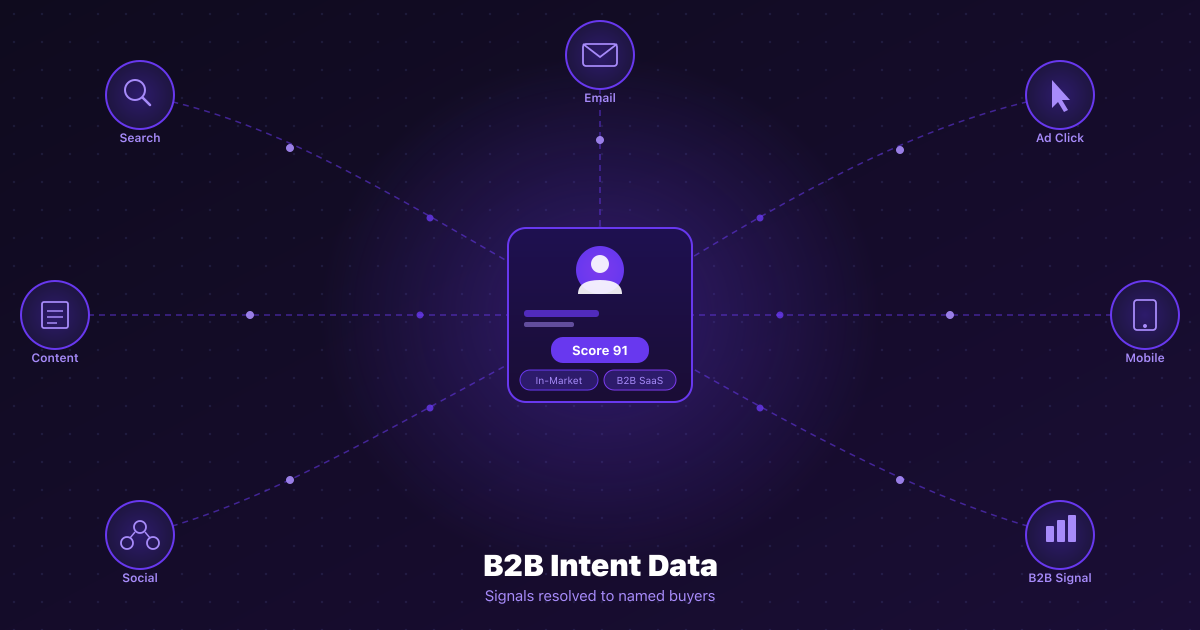
Intent data adds the timing layer. It captures observed online browsing activity, specifically the content people are actively reading and the topics they are researching, across a large network of digital properties, and links that activity to real identified individuals. When someone is actively researching products in your category right now, that behavior shows up as an intent signal tied to their identity.
This kind of intent-based timing does several things simultaneously: it improves conversion rates by concentrating spend on the highest-intent fraction of your audience at the moment of peak interest, reduces wasted impressions on people who are between shopping cycles, and gives you a signal about which product categories or promotional themes are most relevant for a given audience segment at a given time.
A lot of what is marketed as "intent data" is actually modeled interest, demographic profiles scored against historical purchase data. Observed intent data is different: it doesn't predict that someone might be interested based on who they are. It observes that they are actively researching based on what they are doing. For time-sensitive promotional planning, this distinction matters significantly.
How the Two Layers Work Together in Practice
The most effective eCommerce promotion strategy uses both layers in combination, with each layer addressing what the other cannot.
Audience creation from external data solves the who problem: it gives you a defined, identified, contactable population of people who match your target buyer profile and have the contact information needed to reach them across channels.
Intent data solves the when problem: it tells you which portion of that audience is actively in a shopping mindset right now, so you can calibrate your outreach timing and frequency accordingly.
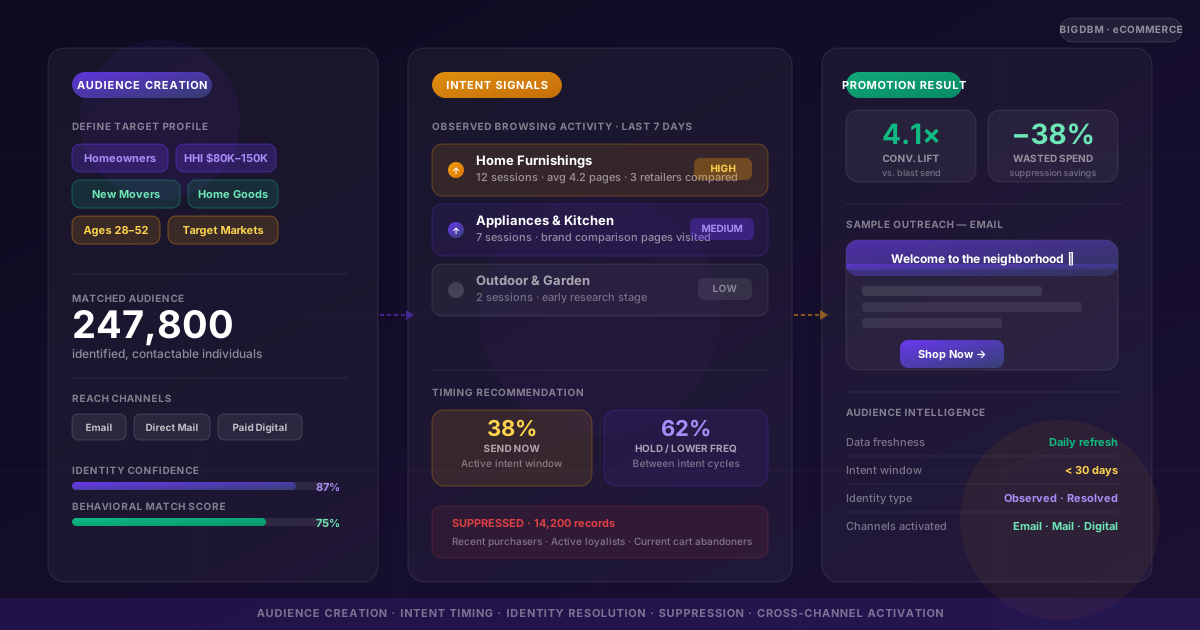
A simplified version of how this works in practice: you build an audience of new homeowners in your target geographic markets who have demonstrated shopping behavior in home furnishings and decor categories. Against that audience, you layer intent signals. Some portion of those new homeowners is actively browsing home furnishings content right now. That subset gets prioritized in your email and paid media scheduling. The rest of the audience is held for later or reached at a lower frequency until their intent signals increase.
The result is a promotion that goes to people who are genuinely likely to buy, at the moment they are most likely to act on it. This is the difference between treating your audience as a static list to be blasted and treating it as a dynamic population with varying levels of readiness that you can observe and respond to in close to real time.
The Suppression Side of This Equation
It is worth addressing suppression explicitly because it is underrated as a lever in promotion efficiency.
Every dollar you spend reaching someone who should be excluded from a campaign is a wasted dollar. That includes recent purchasers receiving acquisition offers, high-LTV loyalists receiving win-back discounts they do not need, and active cart abandoners being served top-of-funnel awareness ads when they are one click from converting.
Effective suppression requires the same identity resolution capability that makes good audience creation possible. If you cannot reliably match a customer's email address to their device ID to their mailing address, you cannot suppress them reliably across channels. They receive the acquisition email on Monday, see the retargeting ad on Tuesday, and get the direct mail piece on Friday, all while being a perfectly happy existing customer.
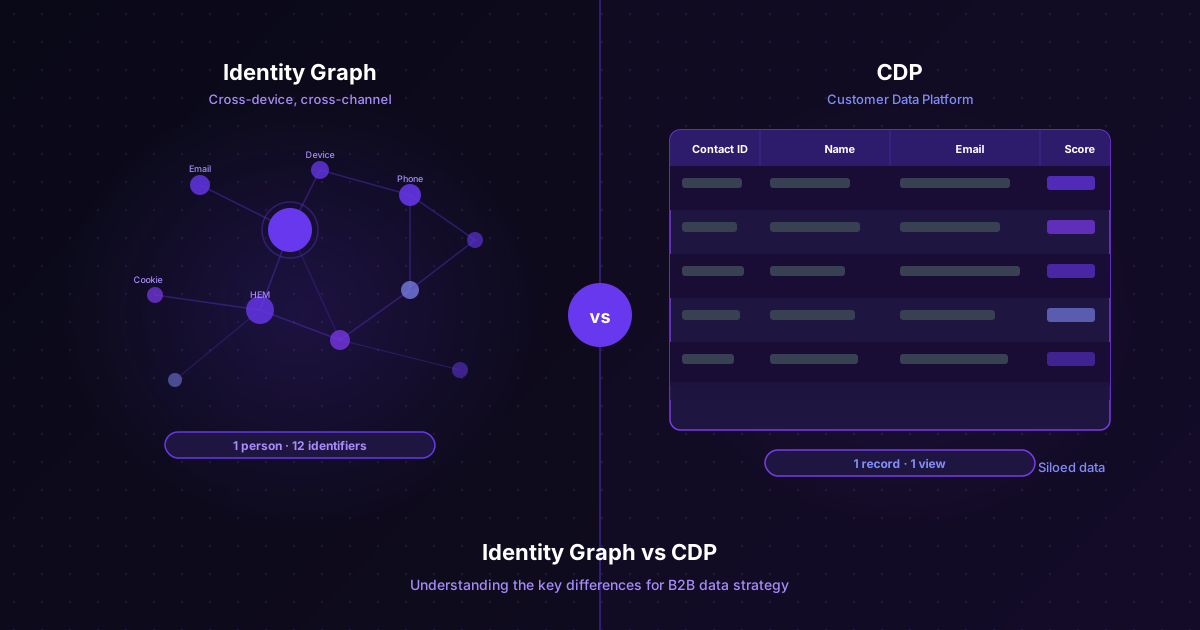
Identity resolution across channels, the ability to connect a single individual's various identifiers into one coherent profile, is what makes suppression actually work at scale. Without it, you are spending money reaching people you should be excluding, which is both costly and, in the case of over-messaging loyal customers with irrelevant promotions, quietly damaging to the customer relationship.
What Good Audience Strategy Actually Requires
A few principles are worth stating plainly for any eCommerce team trying to improve how they build and activate audiences.
The customers in your CRM represent a sample of who might buy from you, not a ceiling. Building audience strategy entirely from first-party data means perpetually marketing to the same people and missing the much larger population of likely buyers who have not found you yet.
A list of 500,000 demographically matched consumers built from survey data two years ago is less useful than a list of 50,000 people whose observed behavior in the last 30 days indicates active shopping in your category. The size of an audience file is not a proxy for its quality.
The decision about when to reach someone is as important as the decision about who to reach. Building intent-based timing into your promotional calendar, rather than sending to your full audience on a fixed schedule, changes the fundamental economics of a campaign.
Every sophisticated audience strategy includes as much thought about who not to reach as about who to reach. Suppression lists should be refreshed frequently, unified across channels, and treated as a first-class component of campaign setup.
Audience creation and intent data are powerful precisely because they involve real, identified individuals. Data should come from sources with documented consent, opt-out processing should be functional and timely, and permitted-use controls should be in place. Building audience strategy on compliant data is not a limitation on what you can do, it is the condition under which doing it is sustainable.
Frequently Asked Questions
How is audience creation from external data different from buying a list?
The term "list buying" traditionally implies a static file of names and contact information selected by broad demographic criteria. Audience creation from a high-quality identity graph is something different: it starts with behavioral and contextual attributes that reflect actual consumer behavior rather than demographic proxies, the underlying data is continuously refreshed rather than static, and the output is scored for confidence so you can filter for quality rather than treating every record as equivalent. The practical difference is that a well-built audience from current identity data contains people who look and behave like your actual buyers, rather than people who demographically resemble them.
Can intent data tell me what product category someone is shopping in?
Yes, when the intent data is properly classified. Intent signals organized by IAB content categories allow you to filter for people researching specific shopping categories: consumer electronics, home goods, apparel, sporting goods, and so on. This means you can build category-specific in-market audiences rather than treating all shopping intent as equivalent.
What is the difference between in-market audiences on ad platforms and third-party intent data?
Ad platform in-market audiences are built from behavioral signals within that platform's own ecosystem and are used exclusively within that platform. Third-party intent data from an identity-resolved source is platform-agnostic: you receive the actual identities of in-market individuals, complete with contact information, and can activate them across email, direct mail, SMS, and any ad platform simultaneously. Platform audiences also do not give you the underlying identity, which means you cannot match them against your CRM, build suppression lists, or use them in offline channels.
How often does intent data need to be refreshed to be useful for promotions?
For promotional timing purposes, intent data that is more than 30 days old loses significant value because shopping intent windows are short. Daily or weekly refresh cadences are standard for intent feeds used in active campaign management. If you are pulling intent data on a quarterly basis, you are likely using it for strategic planning rather than campaign timing, which is a valid but different use case.
Does this kind of audience strategy require a large data team to execute?
Not necessarily. The most accessible versions of this capability are self-service platforms where you configure your audience parameters, specify your intent categories and geographic targets, and receive a file of identified, contactable individuals without requiring a data engineering team to build the pipeline. The complexity scales with the sophistication of the use case, but the entry point for most eCommerce marketing teams is relatively straightforward.
The Underlying Shift
The broader shift that all of this reflects is a move from calendar-driven, volume-based promotion strategy toward a model where promotional investment is concentrated on people who are most likely to respond, at the moments when they are most ready to act.
That shift is being driven partly by the rising cost of media, which makes spray-and-pray less economically viable than it was five years ago. It is being driven partly by the degradation of the cookie-based targeting infrastructure that digital marketers relied on for the past decade, which is forcing the industry toward identity-resolved first-party and third-party data as a replacement. And it is being driven partly by consumer expectations: people have lower tolerance for irrelevant promotional messages than they used to, and brands that consistently reach them with the wrong offer at the wrong time erode the relationship over time.
Audience creation and intent data are not new concepts. What has changed is the quality and accessibility of the underlying data, and the degree to which building this capability has shifted from a nice-to-have for sophisticated teams to a practical necessity for any eCommerce brand that wants to compete on marketing efficiency.
If you want to explore how audience creation and intent data fit into your eCommerce promotional strategy, BIGDBM's Intelligence Marketplace offers self-serve access to both, with identity-resolved outputs, daily-refreshed intent signals, and no contract required to get started. Talk to a data expert or explore the platform to see it in action.