If you've ever tried to find out who owns a commercial property, you've probably hit the same wall: the owner is listed as some variation of "Saguaro Holdings LLC" or "Desert Cap Group," and that's where the trail goes cold.
It's not an accident. LLCs are a legitimate and widely used tool for holding real estate. But for anyone who needs to reach the actual decision-maker, whether you're in commercial lending, industrial sales, property acquisition, or B2B outreach, a shell company name doesn't get you very far.
So how do you get from the LLC to the person?
Why So Much Commercial Property Is Held in LLCs
Before we get into the "how," it helps to understand the "why."
Holding real estate through an LLC is standard practice. It limits personal liability, simplifies ownership transfers, can offer tax advantages, and keeps ownership somewhat private. A single investor or investment group might own dozens of properties through a network of separate LLCs, each one named something that reveals nothing about who's actually behind it.
This is completely legal and extremely common. According to public records data, there are over 9 million non-residential properties in the United States held by corporate entities. That's warehouses, office buildings, retail centers, industrial facilities, and more, all technically owned by companies, not people.
The problem is that when a company owns a property, standard property records stop at the entity name. You get the LLC, but not the humans who control it.
The Gap Between Property Records and People
Most commercial real estate databases are excellent at the property side of the equation. You can find square footage, lot size, purchase price, tax details, zoning, and all the physical characteristics you'd want.
What they struggle with is the ownership layer, specifically connecting the LLC on the deed to the actual principals who own or control it.
That connection requires a different kind of data: business entity filings, principal records, registered agent data, and contact enrichment layered on top of property records. It's not impossible to piece together manually, but it's slow, and it doesn't scale. A researcher working through county assessor records and Secretary of State databases can expect to spend hours resolving a single LLC to a contactable individual. Multiply that across a territory of thousands of properties and the approach breaks down entirely.
How LLC-to-Owner Matching Actually Works
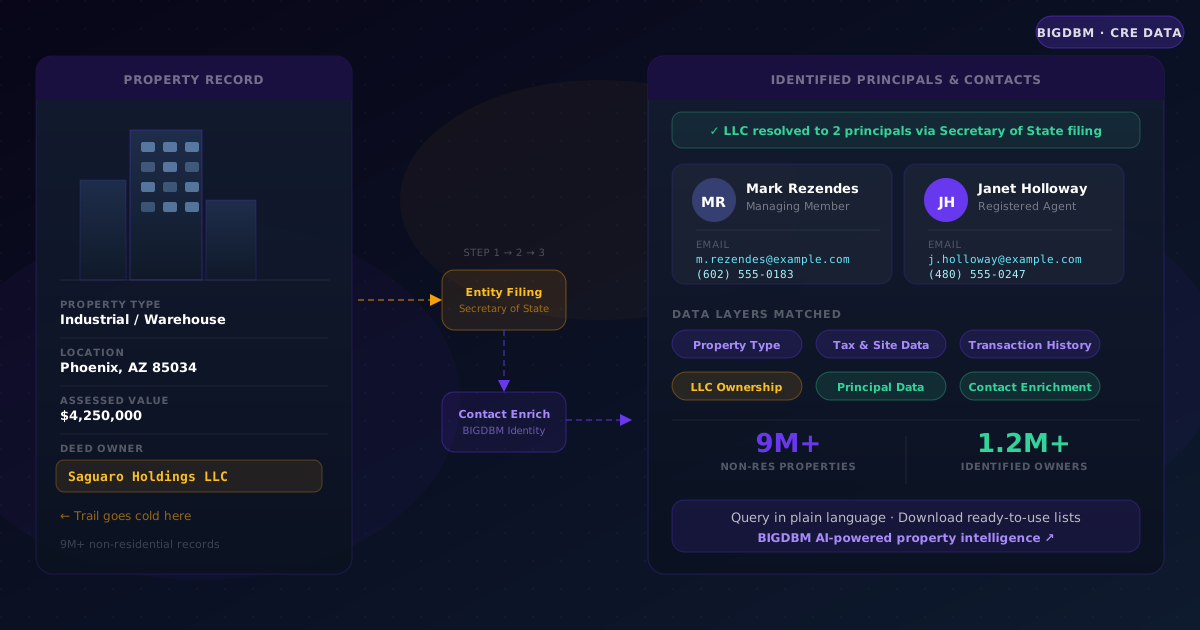
The core idea is straightforward: cross-reference property ownership records with business entity data to identify the principals behind each LLC. In practice, it moves through three distinct steps.
Identify the owning entity
Pull the LLC name from the property deed or tax record. This part is relatively easy, it's public information in most counties. Every commercial property has a deed owner on record, and county assessor data makes this broadly accessible.
Resolve the entity to its principals
This is where it gets harder. Business entity filings (filed with the Secretary of State in each state) often list registered agents, members, or managers, but the completeness varies wildly by state and entity type. Layering in additional sources like beneficial ownership data, court records, and commercial databases helps fill the gaps. The result is a named individual linked to the LLC.
Enrich with contact data
Once you know the person's name, the next question is how to reach them. Matching to a consumer or B2B contact database gives you verified phone numbers and email addresses for the principals, the people who actually make decisions about the property. This is where identity resolution makes the difference between a name and a lead.
When done at scale across millions of records, this process becomes a powerful tool for building targeted outreach lists, without weeks of manual research.
What This Looks Like in Practice
Say you're a commercial lender looking for industrial property owners in Phoenix. You don't want the LLC, you want the person who controls the LLC, their email address, and their phone number.
With a connected property-to-owner dataset, you could query something like: "Show me every industrial property in Phoenix held by an LLC, with the principals' contact information." Instead of spending hours in county records and Secretary of State databases, you get a ready-to-use list.
This is the kind of workflow that AI-powered property intelligence tools are starting to make possible, not as a replacement for due diligence, but as a way to dramatically compress the research phase from weeks to minutes.
The same logic applies across use cases. Commercial brokers use it to identify potential sellers before properties hit the market. Industrial sales teams use it to reach the owner of a specific facility type rather than calling general company lines. Property acquisition teams use it to build lists of owners meeting specific criteria, property type, assessed value range, years of ownership, before making the first contact.
The Six Data Layers That Actually Matter
When evaluating any commercial property dataset for the owner-connection use case, the question isn't just "how many properties?", it's which data layers are covered. A dataset that stops at three of the six leaves you doing the hard work yourself.
Property Characteristics
Property type, size, use classification, zoning designation. The foundation of any search.
Site & Tax Details
Assessed value, tax history, lot size, parcel data. Critical for valuation and targeting by financial profile.
Transaction History
Sale price, sale date, transfer records. Reveals ownership tenure and investment patterns.
Ownership Information
The LLC or entity on record at the deed level. Available in most commercial databases, but it's only the starting point.
Principal Data
The humans behind the entity, linked by Secretary of State filings and beneficial ownership records. The hardest layer to get right.
Contact Enrichment
Verified email addresses and phone numbers for identified principals. Turns a name into a reachable lead.
The first three layers are widely available. The last two, principal data and contact enrichment, are where the real differentiation lives, and where most property databases fall short.
A Note on Data Quality and Compliance
Not all property data is created equal. When working with any dataset that includes personal contact information, the right questions to ask before relying on it are:
Due diligence checklist
The Bottom Line
Commercial real estate has always had an information asymmetry problem. The properties are visible; the people who own them often aren't. Connecting those two things, at scale, with verified contact data, is what separates useful property intelligence from a basic property search.
Whether you're prospecting for commercial loans, sourcing acquisition targets, or building a sales territory around property owners, the LLC behind the address is just the beginning. The decision-maker is the destination.
BIGDBM's commercial property file covers 9M+ non-residential properties across the United States, with LLC-to-principal connections and contact enrichment across 1.2M+ identified owners. An AI chatbot lets you query the dataset in plain language and download a ready-to-use list, eliminating the manual research phase entirely. Learn more on the BIGDBM Real Estate page or get in touch to see the data in action.