Most B2B marketing teams are chasing the same phantom: finding buyers who are actively looking for what they sell, before those buyers raise their hand. Intent data is the closest the industry has come to solving that problem, but the category is wildly inconsistent, and the gap between a good intent data product and a mediocre one can be the difference between a pipeline multiplier and an expensive dead end.
This guide covers what intent data actually is, how it's collected, the critical distinctions buyers miss when evaluating providers, five proven use cases, and the questions you should ask before signing anything.
What Intent Data Is (and Isn't)
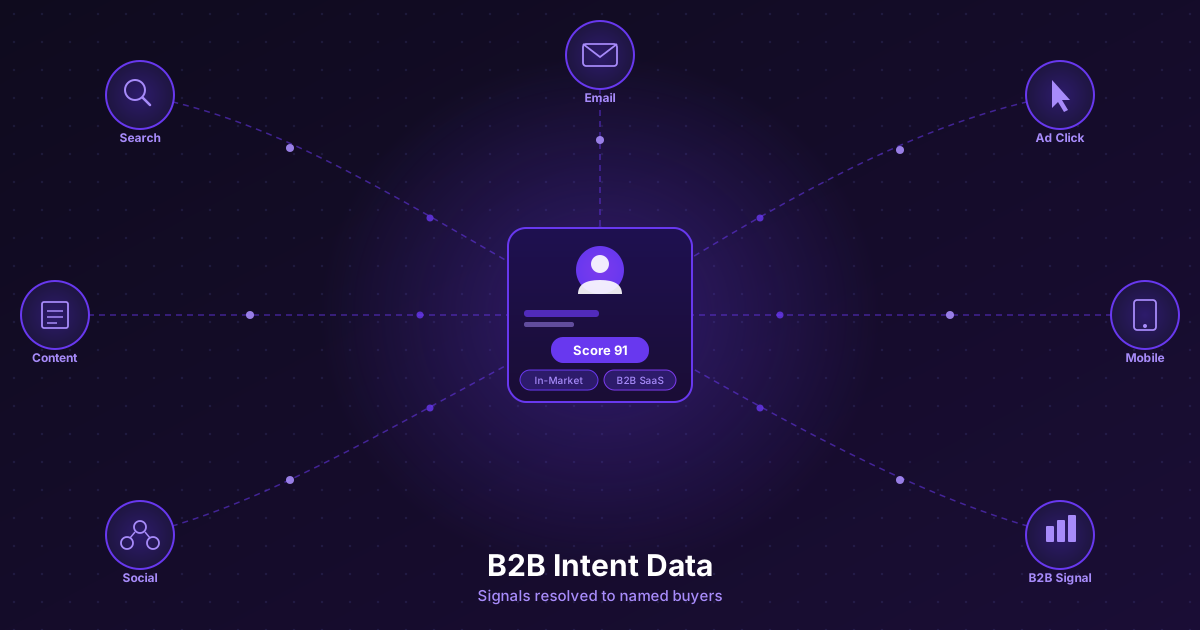
Intent data is behavioral signal data that indicates a person or company is actively researching a topic, product category, or problem. Right now, not six months ago. The underlying premise is straightforward: when someone visits a webpage about "enterprise data enrichment platforms," reads a comparison post about two identity vendors, or downloads a whitepaper on CCPA compliance, that behavior reveals something about what they're thinking about. Intent data captures those signals at scale and packages them in a way marketers and sales teams can act on.
What intent data is not is a list of people who said they're interested in buying something. It's observed behavior, inferred from browsing patterns, not declared preference. That's an important distinction because it means intent signals are probabilistic: they indicate elevated likelihood of interest, not confirmed purchase intent. The quality of the inference depends almost entirely on how fresh the signals are, how they're classified, and whether they're attached to a real, identified person or just an anonymous device.
The core promise of intent data: reach companies and individuals while they are actively researching your category, before your competitors even know they exist as a prospect.
The Two Types: First-Party vs. Third-Party Intent
First-party intent
First-party intent is the behavioral data your own properties generate. Website visits, page depth, content downloads, demo requests, search queries on your site, email open patterns: all of it is first-party intent data, and it's the highest-quality signal you can have because you know exactly who did what and when. The problem is coverage: first-party signals only tell you about people who already found you. For pipeline generation, that's not enough.
Third-party intent
Third-party intent data is collected from publisher networks, content aggregators, review platforms, research sites, news outlets, and other media properties across the open web, then aggregated into a single signal feed you can subscribe to. This is where the category gets interesting and where the quality differences between providers become stark. The two fundamental questions to ask about any third-party intent product are: how are the signals collected? and what identity is the signal attached to?
How Third-Party Intent Signals Are Actually Collected
There are several collection mechanisms in the market, and they produce signals of meaningfully different quality.
Bidstream data is captured from programmatic advertising auctions. Every time a webpage triggers an ad auction, a bid request is generated that includes the URL of the page being loaded. At massive scale, aggregating those URL signals across millions of auctions produces a picture of what people are reading across the open web. The advantage is volume and breadth. The disadvantage is signal accuracy: bid requests were designed for ad targeting, not intent measurement, and the URL alone without session context is a weak signal. A single page view doesn't tell you whether someone spent 12 minutes reading or bounced in three seconds.
Co-op networks are consortia of publishers (typically B2B content sites, trade publications, and research platforms) that pool their first-party behavioral data in exchange for insights. Vendors like Bombora operate on this model. The advantage is richer session-level data (time on page, scroll depth, content interactions). The disadvantage is that coverage is limited to the publishers in the network, which skews toward certain verticals and leaves significant gaps outside the co-op's participating sites.
Observed URL-level data, the approach BIGDBM uses, captures actual page visit signals from consented data sources across millions of U.S. digital properties, classified by IAB content category. The signals reflect real browsing behavior against a broad content taxonomy rather than auction metadata or a walled publisher garden.
The Problem Nobody Talks About: Device vs. Identity
This is the most important quality distinction in the intent data market, and most buyers never ask about it.
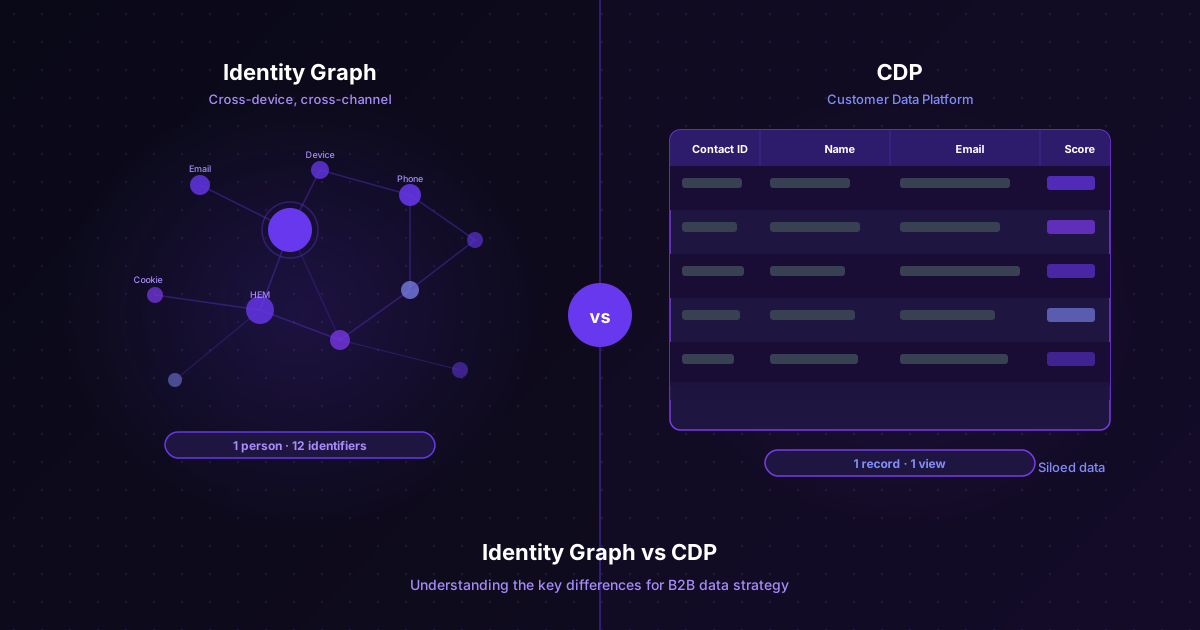
The majority of intent data products attach signals to a device (a cookie, a mobile advertising ID, or an IP address) rather than to a real, identified person. That means when you receive a list of "companies showing intent for enterprise software," what you're actually getting is a list of IP addresses or cookie IDs that were resolved to a company domain. You don't know who at that company was browsing. You don't have a contact name, an email address, a phone number. You have an anonymous signal that someone at that IP address was on a relevant page.
The practical consequence is that acting on device-level intent requires a second enrichment step: you need to take that company domain, find the right contacts within that company, and then hope that the person you reach out to is the same one who was doing the research. That's two layers of inference stacked on each other, and the signal degrades significantly at each step.
Identity-resolved intent data skips that gap entirely. The signal is already attached to a named individual with verified contact information. You know who was researching, not just where the traffic came from.
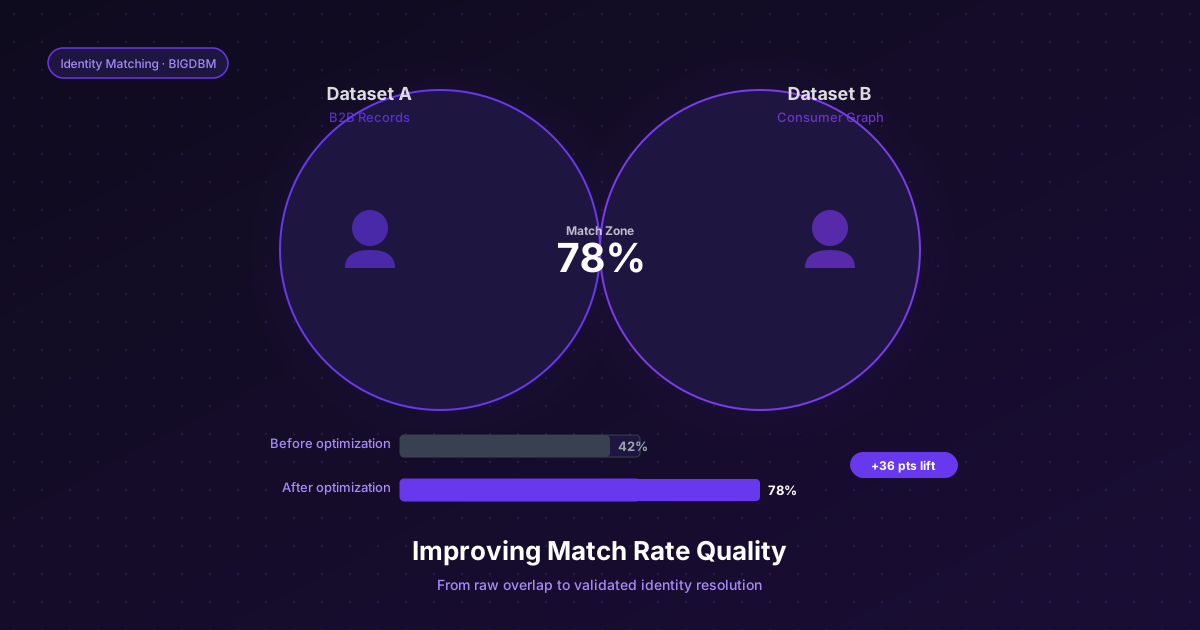
BIGDBM's intent data in the Intelligence Marketplace is identity-resolved at the point of collection, meaning behavioral signals are linked to real consumer and B2B profiles in BIGDBM's identity graph before they're delivered. You receive intent signals with name, email, phone, company, and demographic attributes attached. No separate resolution step. No domain-to-contact guesswork.
What Good Intent Data Looks Like: A Comparison
| Dimension | Device-Level Intent | Identity-Resolved Intent |
|---|---|---|
| Signal attachment | Cookie ID or IP address | Named individual with verified contact fields |
| Activation readiness | Requires separate enrichment step | Ready for direct outreach immediately |
| Refresh cadence | Varies; often weekly or slower | Daily refresh, so signals reflect what's being researched right now |
| Category classification | Proprietary buckets, variable quality | IAB tier-1 and tier-2 taxonomy |
| CRM match capability | Domain match only; contact match requires enrichment | Direct match to existing CRM records |
| Suppression list use | Limited without identity resolution | Can suppress opted-out individuals directly |
Five Ways B2B Teams Use Intent Data in Practice
1. Prioritizing outbound sequences by active research signal
Instead of working a static account list in sequential order, sales teams layer intent signals on top of their ICP to identify which target accounts are in an active research window right now. A prospect who was browsing content about your category this week gets prioritized over an equally qualified prospect who shows no signal. The result is higher connect rates and shorter time-to-conversation because you're reaching people when the problem is top of mind, not when it's convenient for your cadence schedule.
2. Triggering ad campaigns against in-market audiences
Intent signals fed into a DSP or social ad platform allow you to serve ads specifically to individuals or companies that are actively researching your category. Because the audience is defined by observed behavior rather than job title or firmographic filters alone, the relevance is higher and the cost-per-engagement typically lower. When the intent feed is identity-resolved, the match rate to ad platforms is also significantly better than with device-level signals.
3. Enriching CRM records with behavioral context
Appending intent signals to existing CRM contacts gives your sales team context they can't see anywhere else. A contact who's been dormant for six months but suddenly shows intent signals across three categories related to your product is worth a personalized outreach. Your rep walks into that conversation knowing what the contact has been reading, which makes for a much sharper opener than a generic check-in email.
4. Building suppression lists to avoid wasted spend
Intent data isn't just for finding who to target. It's equally useful for finding who to exclude. If you can see that a company recently went through a major platform evaluation and signed a contract with a competitor (based on vendor-specific research signals going dark), you can suppress that account from campaigns for a cooling-off period rather than burning budget on a closed door.
5. Identifying net-new prospects outside your CRM
Intent data surfaces companies and individuals showing buying signals who have never engaged with your brand at all. When those signals are identity-resolved, they arrive with a contact record you can immediately import into your CRM and begin working. This is particularly powerful for category-level intent, like signals showing interest in "enterprise data management" or "marketing data compliance", where you want to capture the full demand universe, not just the slice already aware of you.
What to Ask Before You Buy Intent Data
The intent data market is crowded and the claims are often indistinguishable from one vendor to the next. These are the questions that separate meaningful answers from marketing language:
- Are signals attached to an identified person or a device? If the answer is a device, ask what the resolution process is and who performs it, because you're essentially paying to patch a gap in their product.
- How fresh are the signals? Intent data has a short half-life. A weekly feed is often already stale before it's actionable. Ask specifically whether signals are refreshed daily.
- How are topics classified? Proprietary taxonomy with vague buckets makes cross-vendor comparison impossible. IAB-classified categories are standard and auditable.
- What is the source of the signal? Bidstream data, co-op network data, and observed URL data have different quality profiles. Know what you're getting.
- Can I match intent signals directly against my CRM? If the answer requires a separate vendor or workflow, the integration cost is higher than it appears.
- How is the data compliant? Ask specifically about consent management, opt-out processing, and CCPA coverage. A vendor that can't answer in detail is a compliance risk you own.
- Can I see a sample against my own ICP? Any reputable intent data provider should be able to show you signal volume against your target account list before you commit.
The Identity-First Difference
The intent data category is maturing fast, and the vendors who built their products around device-level signals are scrambling to layer identity resolution on top after the fact. The problem with that approach is that bolt-on resolution introduces a match rate ceiling and a data freshness tax. By the time device signals are collected, batched, and resolved to a named individual, the signal can be days old.
Building intent on top of an identity graph, rather than trying to resolve devices into identities after the fact, produces a fundamentally better product. It's why BIGDBM's intent data is delivered with full consumer and B2B identity attributes attached from the start, refreshed daily, and available through the Intelligence Marketplace without a separate enrichment workflow or a custom data order.
For B2B teams that have been burned by intent data that was too stale to act on, too anonymous to personalize, or too expensive to justify the operational overhead of resolving it: the identity-first architecture isn't a nice-to-have differentiator. It's the prerequisite for intent data that actually works.