If you've spent any time in the data and marketing technology space, you've heard both terms tossed around, sometimes interchangeably, which causes real confusion when it comes time to make a purchasing decision. An identity graph and a customer data platform (CDP) are different tools that solve different problems. They can work powerfully together, but conflating them leads to buying the wrong thing or, worse, underutilizing what you already have.
Let's break down exactly what each one does, where they overlap, and how to decide what you actually need.
What Is an Identity Graph?
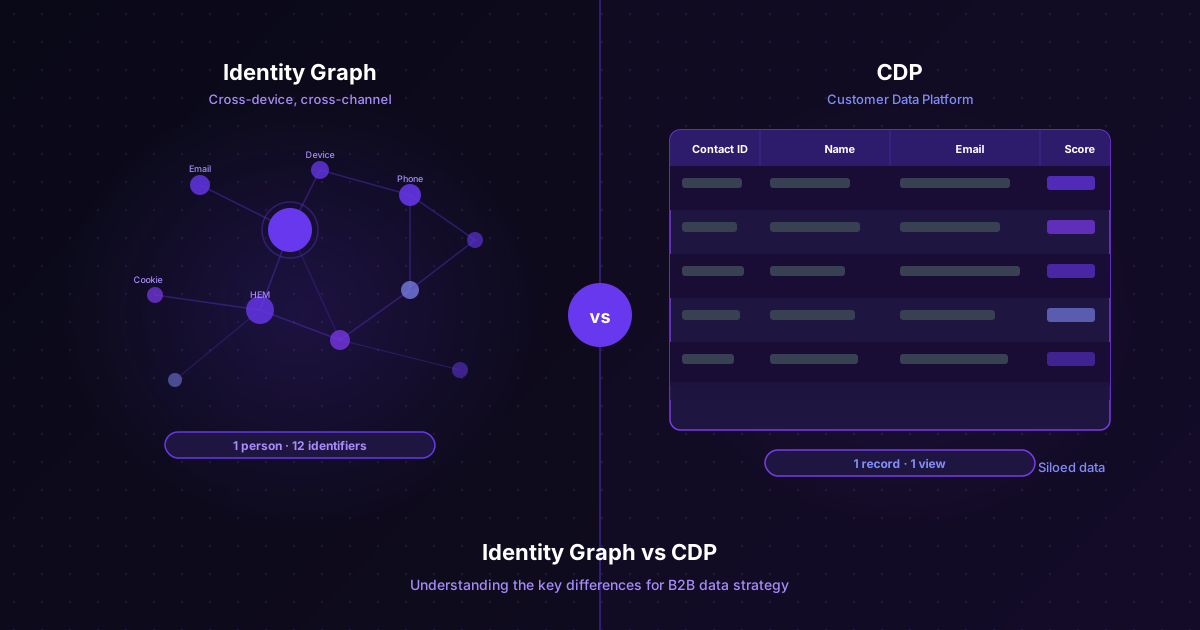
An identity graph is a database that maps all the known identifiers for a given person, email addresses, phone numbers, device IDs, postal addresses, hashed identifiers like SHA-256 emails, and digital tokens like RampIDs or UID 2.0, to a single persistent profile. The graph's job is resolution: taking fragmented, multi-touchpoint data and connecting it to a real, deduplicated human being.
Identity graphs operate at the infrastructure layer. They don't manage campaigns, segment audiences for email sends, or run A/B tests. They answer one fundamental question: is this device the same person as this email address? The answer to that question, and the confidence level attached to it, is what powers everything else downstream.
BIGDBM's Trusted Identity Graph is built on hundreds of millions of US consumer records, refreshed continuously, with full lineage on every link so you know exactly where each connection comes from. That transparency is what makes the graph defensible for compliance purposes and trustworthy for activation.
What Is a CDP?
A customer data platform is an application layer that ingests data from multiple sources, your website, email platform, CRM, point of sale, ad platforms, and creates unified customer profiles that marketing teams can act on directly. CDPs are designed to be marketer-friendly: they expose audiences, segments, and activation workflows through a UI, without requiring deep engineering work for every use case.
CDPs are excellent at managing what you already know about your customers from your own first-party sources. They unify behavioral data, transaction history, and campaign engagement into a single view. What most CDPs are not designed to do is resolve identity across external touchpoints or enrich first-party profiles with third-party signals like verified phone numbers, address history, or household composition.
Where They Overlap, and Where They Diverge
Both tools produce a unified customer profile, which is why the confusion happens. But they approach that profile from opposite directions. A CDP unifies what your own systems know. An identity graph resolves who the person actually is across all systems, including ones you don't own.
CDPs depend on the quality and completeness of your first-party data. If a customer browsed your site anonymously on a mobile device and then purchased on desktop three days later, your CDP will treat those as two people unless it has a deterministic link, like a login event, connecting them. An identity graph fills exactly that gap. It can probabilistically or deterministically link those two sessions based on household, device cluster, and behavioral signals that your first-party systems never captured.
The other major difference is refresh rate and source diversity. CDPs update in near-real-time based on your own event streams. Identity graphs need to be continuously refreshed against massive, multi-source datasets to stay accurate as phone numbers change, people move, and devices turn over. That's an infrastructure investment that's separate from, and complementary to, your CDP.
When Do You Need One vs. the Other vs. Both?
You need a CDP if you have substantial first-party data spread across multiple systems and your marketing team spends too much time reconciling them manually. A CDP gives you operational leverage: faster segmentation, better personalization, cleaner suppression lists.
You need an identity graph if you're trying to reach people across channels where you don't have a direct relationship, programmatic advertising, data clean rooms, partner activations, or if your first-party match rates on paid platforms are running below 40%. An identity graph extends your reach and improves the accuracy of every match downstream.
You need both if you want to close the full loop: use the identity graph to enrich and expand your first-party profiles, then feed those enriched profiles into your CDP for activation. The identity graph improves the raw material; the CDP improves how you use it. Together, they produce a customer view that's both complete and actionable.
A Practical Decision Framework
Start by diagnosing your current gaps. If your primary pain is operational, too many disconnected systems, slow time-to-segment, campaign suppression failures, a CDP is likely the right first investment. If your primary pain is coverage, you can only reach 30% of your customers on connected TV, your lookalike audiences are thin, your onboarding match rates are disappointing, an identity graph addresses the root cause.
The most common pattern we see at BIGDBM is teams that already have a CDP but are frustrated by the quality of what they're feeding into it. Enriching your first-party data with a high-confidence identity graph before it enters the CDP resolves most of those frustrations at the source, rather than trying to compensate for poor data quality with more sophisticated CDP configurations.
Whatever path you choose, the key is to evaluate each tool on its actual architecture, not its marketing positioning. Ask vendors to show you match rates on your own file, explain their refresh cadence, and demonstrate how they handle opt-outs end to end. Those answers will tell you more than any feature matrix.