Think about the last thing you bought online. You probably saw an email about it on your laptop, looked it up later on your phone, and maybe finished the purchase in an app. To you, that was one shopping trip. To most marketing systems, it looked like three different people.
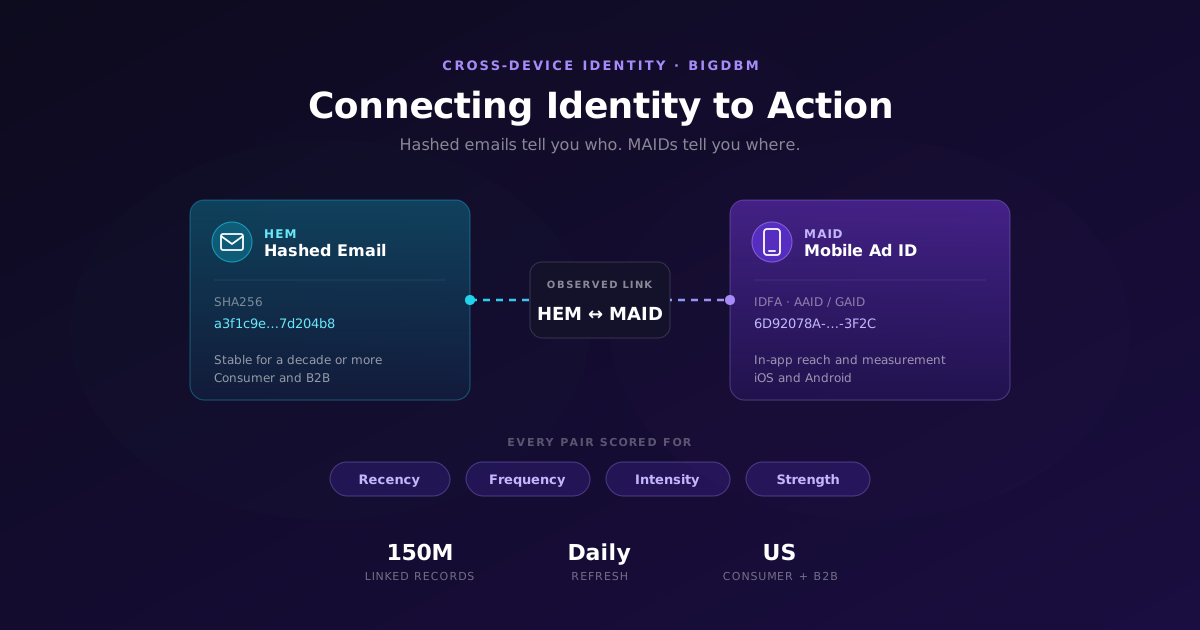
That gap is the problem our HEM and MAID data is built to close. We link hashed email addresses (HEMs) to mobile advertising IDs (MAIDs), so brands can recognize the same person across devices and talk to them in a way that feels consistent instead of scattered.
Why hashed emails make such a good anchor
A hashed email is an email address that has been run through a one-way function like MD5, SHA1, or SHA256. What comes out is a fixed-length string of characters. Nobody can turn that string back into the original address, but if two companies hash the same email, they get the same result. That means they can match records without ever handing each other a real email address.
The real strength of the HEM is how long it lasts. People change phones every couple of years, clear their cookies constantly, and switch jobs more often than they used to. Most of them keep the same personal email for a decade or more. That stability is exactly what you want when you're trying to tie identity together across web, app, and offline channels.
We build on that foundation with observed links between consumer and B2B emails and real online activity. Our hashed emails also connect back to BIGDBM's consumer and B2B databases, so you can add demographic and contact details and get a much fuller picture of each person.
MAIDs: where your customers actually spend their time
A mobile advertising ID is a unique identifier that a phone's operating system gives to the device. On iPhones it's called the IDFA. On Android it's the AAID, which you'll also see called the GAID. Advertisers rely on MAIDs to serve in-app ads, measure results, and understand how people behave on mobile.
The catch is that MAIDs are fragile. A user can reset theirs in a few taps, and on its own a MAID tells you what a device did, not who was holding it. Pair it with a hashed email, though, and that device activity suddenly belongs to a real, lasting identity.
Hashed emails tell you who a customer is. MAIDs tell you where to reach them.
How we connect the two
Our US Daily Consumer and B2B HEM<>MAID product delivers observed links between emails and MAIDs, drawn from website and device activity. Each link lives inside our larger identity graph, which pulls high-quality connections from multiple sources to build out individual and household profiles.
What makes the data useful in practice is the context that comes with each pair. Every record is scored for recency, frequency, intensity, and strength. In plain terms, you can see how fresh a connection is and how much to trust it before you spend money on it. Records can also carry an individual ID along with a linked name, postal address, email, and phone number.
| Attribute | Detail |
|---|---|
| Coverage | United States, consumer and B2B |
| Volume | 150 million records |
| Refresh | Daily |
| Linkage scores | Recency, frequency, intensity, strength |
| Linked fields | Individual ID, name, address, ZIP+4, email, phone |
| Delivery | Amazon S3 or SFTP, in CSV or JSON |
| Pricing | Custom quote based on your needs |
What teams are doing with it
We see customers put this data to work in a handful of ways. Here are the ones that come up most often.
- Reaching customers on mobile. Upload your hashed customer emails, match them to MAIDs, and you can show those same customers in-app and mobile ads.
- Cleaning up identity. Platforms use the links to merge scattered device and email records into one profile per person. Fewer duplicates means less wasted spend.
- Building richer audiences. Adding demographics, contact fields, and intent signals to MAID audiences gives you sharper segments and better lookalike models.
- Proving what worked. When you can tie a mobile ad view back to an email-based customer record, it gets a lot easier to connect a campaign to the sales it drove.
- Taking B2B campaigns to mobile. Because the data covers business emails as well as consumer ones, account-based marketers can reach decision makers on their phones too.
A word on privacy
Hashing is a big part of why this works responsibly. Partners can match audiences without passing plain-text email addresses back and forth, which cuts down the risk of exposing personal data. Privacy, quality, and security sit at the center of how we build our identity graphs, and our privacy policy is publicly available.
That said, every buyer has their own responsibilities too. If you're using HEM and MAID data, make sure your use lines up with state privacy laws like the CCPA, that you honor consumer opt-outs, and that you follow platform rules such as Apple's App Tracking Transparency, which limits access to the IDFA on iOS. Our CCPA compliance checklist is a good place to start.
Turn devices back into people
Your customers aren't three different people on three different screens. Our daily HEM<>MAID data brings those moments together, with scored links and enrichment fields that help you target, measure, and personalize with confidence.
See how it fits your campaigns
Reach out and we'll send you a sample HEM<>MAID file and a custom quote based on your needs.