Spend enough time in marketing circles and you'll hear some version of the same line: first-party data is gold and third-party data is dead. It's a tidy story. It maps neatly onto the deprecation of third-party cookies, growing privacy regulation, and a general cultural shift toward data minimalism. The only problem is that it's mostly wrong, and teams that act on it as gospel are making expensive mistakes in both directions.
First-party data has real blind spots. Third-party data, when sourced and scored correctly, fills them. The actual question in 2026 isn't which party collected the data. It's whether the data is fresh, consent-managed, confidence-scored, and fit for your specific use case. Those four variables determine performance. The "party" label is largely a distraction.
Where the First-Party Halo Came From
The enthusiasm for first-party data isn't irrational. It emerged from a real set of problems: third-party cookies were being deprecated across browsers, GDPR and CCPA created liability for using data collected without proper consent, and a wave of high-profile data misuse stories made compliance a boardroom issue rather than a legal footnote.
In that context, "collect your own data and rely on that" became the safe, politically clean answer. And for some use cases it is genuinely the right answer. If you're personalizing an experience for existing customers who have actively given you their preferences, first-party data is unbeatable. You know who they are, what they've done, and they've explicitly chosen to engage with you.
But the pivot to first-party-only thinking created a new set of problems that are now showing up clearly in performance data.
The Real Limits of First-Party Data
Coverage gaps are structural, not fixable
First-party data only covers people who have already found you and engaged with you. For most businesses, that's a small fraction of the addressable market. A typical B2B SaaS company might have detailed behavioral data on a few thousand accounts in their CRM while the actual ICP universe runs into hundreds of thousands of companies. A retail brand might have purchase history on 2 million customers while their total addressable audience is 50 million households. The people you haven't reached yet don't exist in your first-party data, and no amount of data quality improvement changes that structural ceiling.
Decay is faster than most teams realize
First-party data decays quickly. Email addresses churn at roughly 25-30% per year for consumer lists. People change jobs, relocate, switch devices, and abandon email addresses. A CRM that hasn't been enriched or validated in 18 months is running on a meaningfully degraded dataset, even if it looks the same in your system. The records are still there. The people behind them have moved on.
The cold-start problem kills new initiatives
Every time you launch a new product, enter a new market, or target a new segment, you start with no first-party data at all. You can't build a lookalike audience from zero. You can't suppress existing customers because there aren't any yet. You can't personalize for a segment you've never engaged with. First-party strategies require a history to work from, which means they're structurally disadvantaged for growth and expansion use cases.
Self-reported data has its own accuracy problems
Not all first-party data is behavioral. A significant portion of it is self-reported: job titles on registration forms, stated income ranges, claimed interests. People regularly misrepresent themselves, underreport, or simply fill in whatever gets them through the form fastest. A first-party dataset built on self-reported fields is not inherently more accurate than a well-maintained third-party dataset built on observed behavior and verified records.
The first-party data advantage is real for retention and personalization. For growth, expansion, and prospecting, it runs out fast. That's where well-sourced third-party data steps in.
What Third-Party Data Actually Covers
The "third-party data is dead" narrative is largely a cookie story. The deprecation of third-party tracking cookies in browsers did kill a specific mechanism for cross-site behavioral tracking without user consent. But that's one input into one type of third-party data product. It says almost nothing about the legitimacy or quality of third-party identity data, demographic data, contact data, property records, or observed behavioral signals collected through consented channels.
High-quality third-party data in 2026 looks nothing like the cookie-based audience segments that were the industry's dirty secret a decade ago. It looks like this instead:
- Consumer identity records sourced from hundreds of opt-in partners, processed through automated consent management and CCPA opt-out suppression
- Phone and email records scored for deliverability and compliance before every use, so quality is measurable rather than assumed
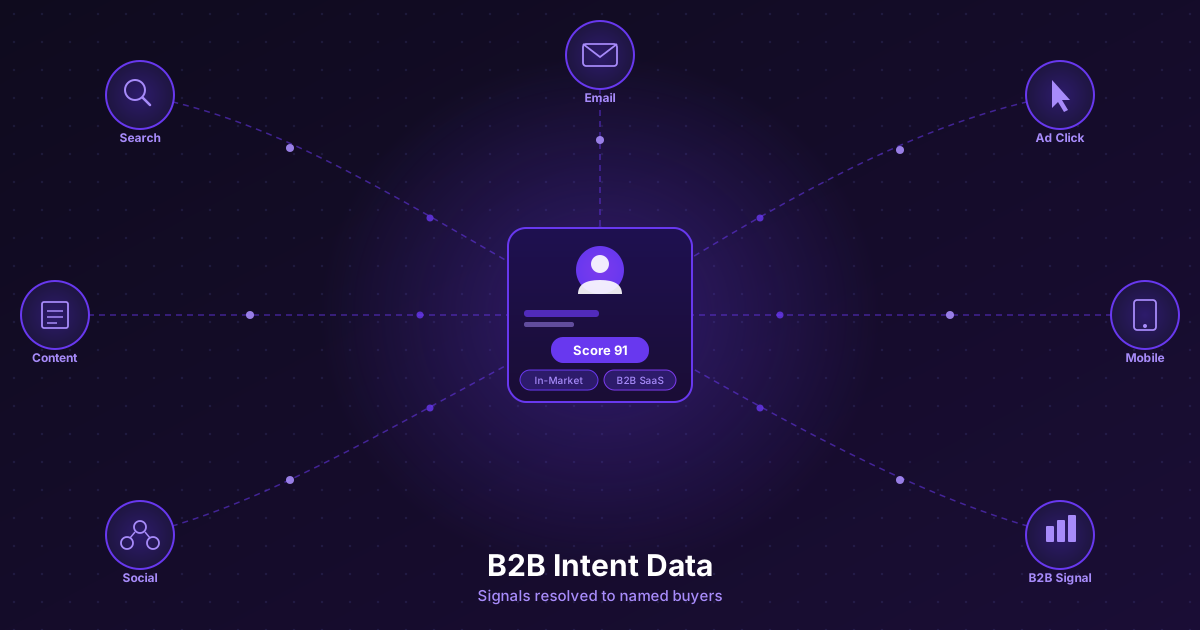
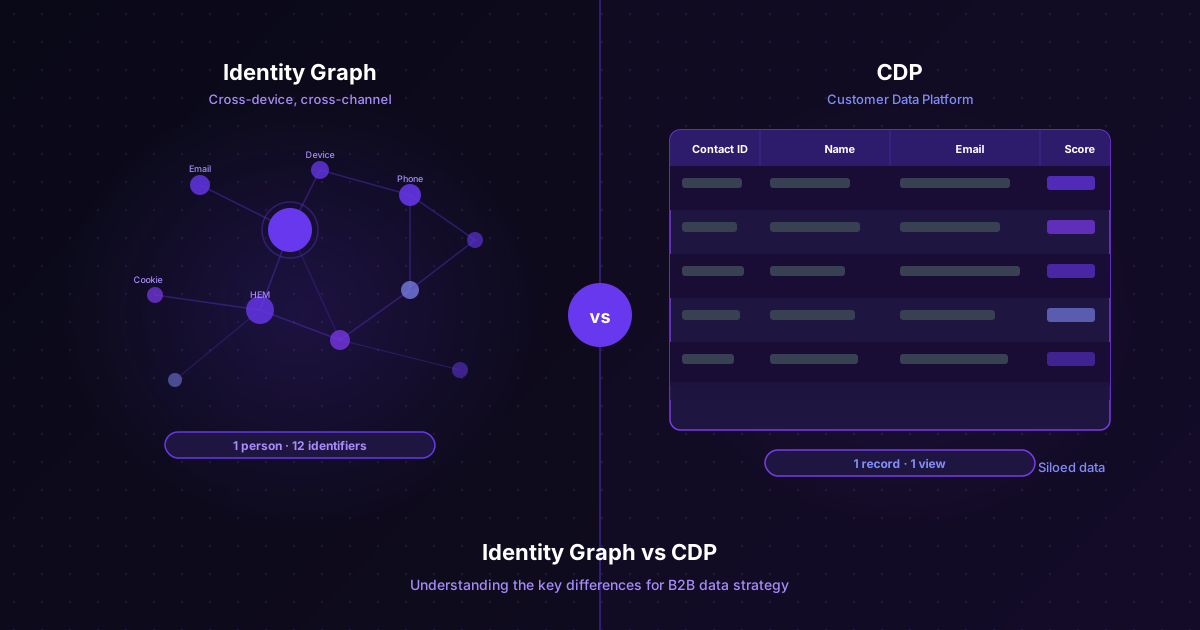
- Behavioral intent signals tied to real, resolved individuals rather than anonymous device IDs
- Property, healthcare, and demographic data sourced from public records and verified directories with known provenance
- B2B contact data continuously refreshed to reflect job changes, company updates, and contact verification cycles
None of that is the privacy nightmare that "third-party data" conjures in a 2018 GDPR-panic context. It's a different product category with different sourcing standards, and the quality signal is increasingly whether the provider can document its consent chain, refresh cadence, and compliance certifications rather than simply asserting that its data is "premium."
What Actually Determines Data Quality
If the first-party vs. third-party label isn't the useful quality signal, what is? Here are the four variables that actually predict whether data will perform.
1. How it was sourced
Consent management is the first gate. Data sourced with explicit consent from individuals who understood what they were agreeing to performs better and creates less legal risk than data scraped, inferred, or collected through opaque processes. For third-party data providers, the meaningful question isn't "is this first-party or third-party?" It's: "Can you show me the consent chain for this record? What opt-out processing have you applied? Are California and Virginia privacy rights requests being honored automatically?"
Providers who can answer those questions with documentation are playing a fundamentally different game than providers who answer with vague references to their "data ecosystem."
2. How it's scored
Raw data without quality scoring is a liability. You don't know which records are current and which are stale. You don't know which phone numbers are active versus disconnected. You don't know which email addresses will bounce. You don't know how confident the identity linkage is between a device ID and a named individual.
Confidence scoring changes all of that. BIGDBM's RFIS framework scores every record across four dimensions: Recency (how recently was this signal observed?), Frequency (how often has it appeared across multiple sources?), Intensity (how strong is the underlying signal?), and Strength (how confident is the identity linkage itself?). The composite score lets you set a quality threshold that matches your use case rather than accepting a black-box record and hoping it performs.
The same logic applies to contact-level scoring. Phone Quality Level (PQL) scoring tells you whether a number is active, what connection type it is, and whether it's on a DNC registry before your first SMS goes out. Email Quality Level (EQL) scoring tells you whether an address will bounce, whether it's associated with a disposable domain, and how recently it showed inbox activity before your campaign even launches. Both are quality gates that apply equally to first-party and third-party contact data.
3. How fresh it is
Data freshness matters more than the party label by a significant margin. A first-party CRM that was last cleaned 24 months ago will outperform a low-quality third-party feed, but it will underperform a well-maintained third-party dataset refreshed monthly. BIGDBM's consumer identity records are refreshed monthly from over 80 underlying sources. MAID linkages are refreshed weekly. Intent and behavioral signals are refreshed daily. That cadence reflects the velocity at which real-world data changes, which is faster than most internal CRM hygiene programs keep up with.
4. Whether it's scored for your specific use case
The same dataset can be high quality for one use case and wrong for another. A consumer file with strong residential address accuracy is ideal for direct mail and not particularly useful for programmatic advertising. Intent signals refreshed daily are critical for outbound sales prioritization and largely irrelevant for identity verification. Quality isn't an abstract attribute of the data itself. It's always relative to what you're trying to do with it.
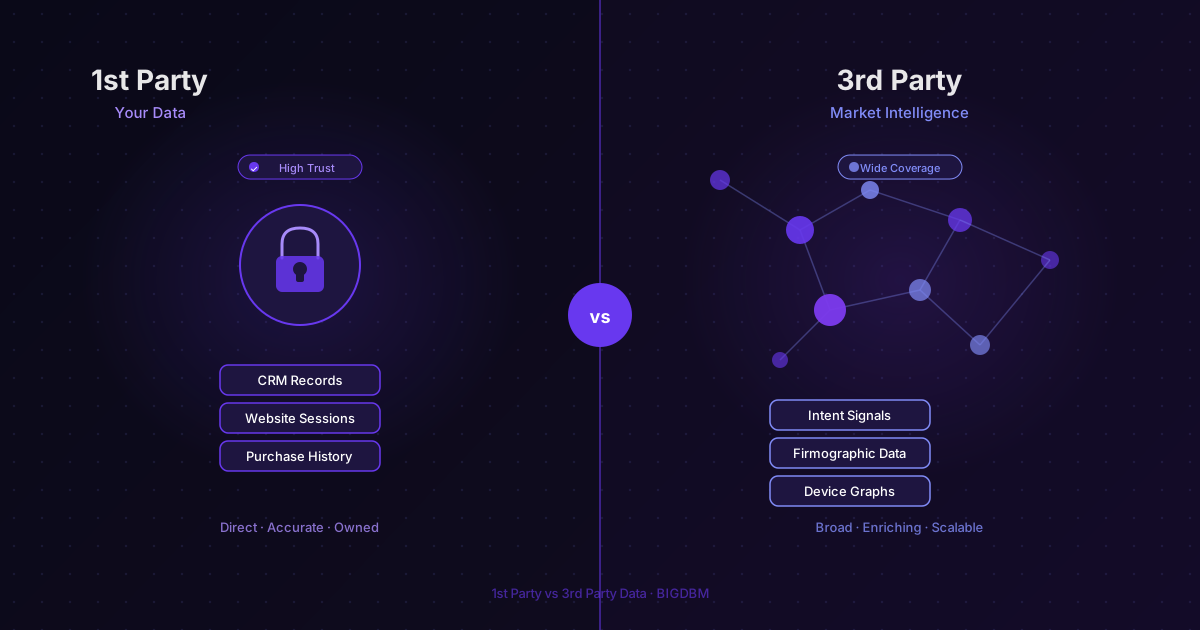
First-party data excels at
- Personalizing known-customer experiences
- Retention and re-engagement campaigns
- Suppression of opted-out or recent purchasers
- Seeding lookalike models (when the base is large enough)
- Compliance documentation for existing relationships
Where first-party data falls short
- Net-new prospecting into unfamiliar segments
- Reaching the 90%+ of your market that hasn't found you
- Launching new products with no CRM history
- Validating and enriching decayed contact records
- Intent signals outside your owned properties
How Privacy Law Changed the Scorecard
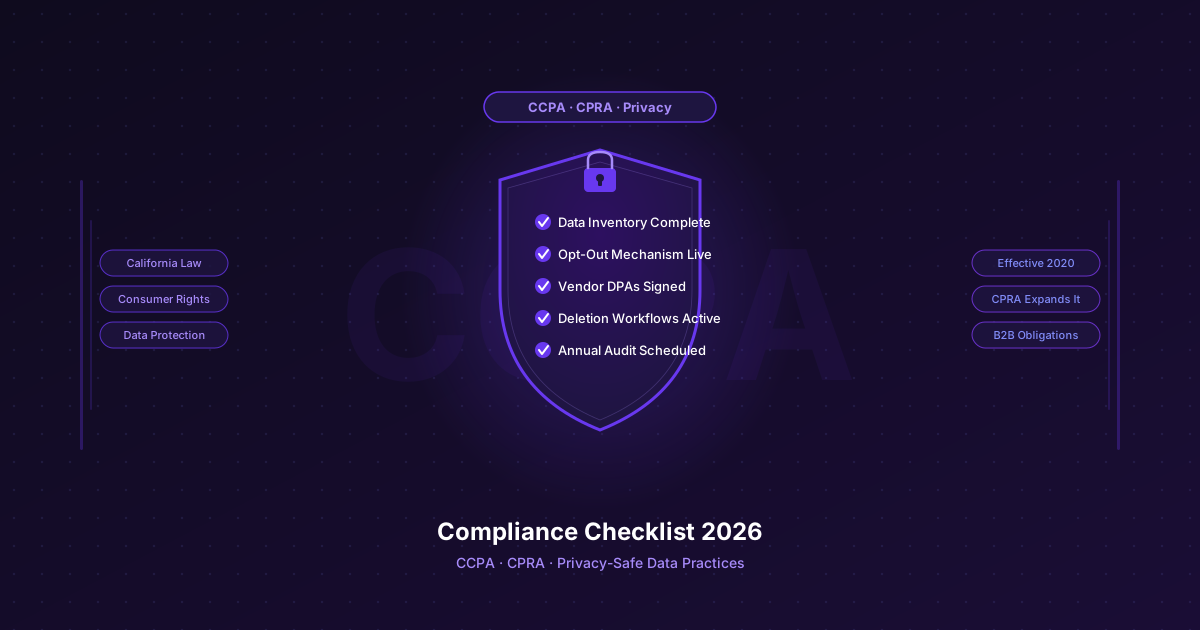
CCPA and CPRA didn't kill third-party data. They raised the floor on what legitimate third-party data looks like, and they made the accountability gap between good providers and bad ones much more visible.
Pre-CCPA, a data provider could plausibly claim it had "sourced data ethically" with no documentation required. Post-CCPA, clients in regulated industries need to verify consent chains, confirm opt-out processing, and maintain audit trails. That documentation requirement effectively split the market: providers who built proper consent infrastructure survived and strengthened, and providers who relied on murky sourcing lost enterprise clients or exited.
The irony is that CCPA and CPRA, which are widely cited as reasons to avoid third-party data, actually created a selection mechanism that made the high-quality tier of third-party data more reliable than it's ever been. A third-party data provider that is SOC 2 Type II certified, TrustArc certified, and IAB Transparency compliant, with automated opt-out processing running continuously, is not the entity that the privacy regulation was designed to constrain. It was designed to constrain providers operating without that infrastructure.
BIGDBM's compliance infrastructure includes all of those certifications, plus automated processing of opt-out requests under California, Virginia, Colorado, and other applicable state privacy laws. The audit trail exists because clients need it, not because it's optional.
The Practical Scorecard: First-Party vs. Enriched Third-Party
What Sophisticated Teams Actually Do
The best marketing and data teams stopped framing this as a binary choice years ago. They use first-party data as the anchor, the source of truth for known customers, existing relationships, and consent records. They use third-party data to extend reach, enrich decayed records, fill gaps in coverage, and surface intent signals from outside their owned properties.
The workflow looks something like this: take your CRM, run it through an enrichment pass to repair stale contact fields and append missing signals. Overlay intent data to identify which accounts are in an active research window right now. Build net-new prospect lists using third-party identity data for the ICP segments you haven't yet reached. Score everything before activation using PQL and EQL so campaigns launch against quality-filtered contacts. Suppress opted-out individuals using the consent records from your first-party data combined with the continuous opt-out processing from your third-party provider.
That approach treats first-party and third-party data as complementary layers rather than competitors. The first-party layer provides relationship history and compliance anchoring. The third-party layer provides coverage, enrichment, and signal.
The Question to Ask Instead
Next time someone on your team or at a vendor says "we're first-party only" as though it's a quality signal in itself, ask these questions instead:
- Can you show me the consent documentation for this data?
- What opt-out processing have you applied and how recently?
- What is the refresh cadence and how does it vary by data type?
- Is there a confidence score attached to each record, and what dimensions does it cover?
- What certifications can you provide for compliance review?
- How does quality degrade if I don't re-enrich this file for six months?
Those questions work for first-party and third-party data equally, because they target the variables that actually determine whether data performs. The party label tells you who collected it. These questions tell you whether it's any good.
BIGDBM's Intelligence Datasets are built around those exact accountability standards: consent-managed sourcing, RFIS confidence scoring on every record, continuous opt-out processing, monthly-or-better refresh cycles, and SOC 2 / TrustArc / CCPA/CPRA compliance documentation available for procurement review. Not because it's a marketing claim, but because enterprise clients require it before any data touches their stack.
In 2026, that's what good third-party data looks like. And for the use cases where first-party data runs out, it's what makes the difference between a campaign that performs and one that quietly doesn't.