Sports have always been defined by the pursuit of marginal advantage. A fraction of a second. A better read on the opponent. A smarter substitution at the 70th minute. What has changed is that the tools for finding those edges are no longer restricted to instinct, experience, and film sessions, they are powered by data infrastructure that would have seemed implausible a decade ago.
Today, professional franchises operate data platforms as sophisticated as mid-size technology companies. Performance analytics, fan identity intelligence, real-time biometric monitoring, and AI-driven decision engines are no longer emerging trends, they are operational standards for any organization serious about winning on the field and growing off of it.
At BIGDBM, sports is one of the sectors where we see data intelligence making the most measurable difference, both inside the white lines and in the business of reaching, identifying, and activating the fans who follow the game.
Performance Analytics: From Clipboards to Confidence Scores
The transition from gut feel to data-driven decision-making in sports happened faster than most industries anticipated. In 2010, a handful of forward-thinking clubs were experimenting with optical tracking systems. By 2026, the absence of a data team in a professional organization is the anomaly, not the norm.
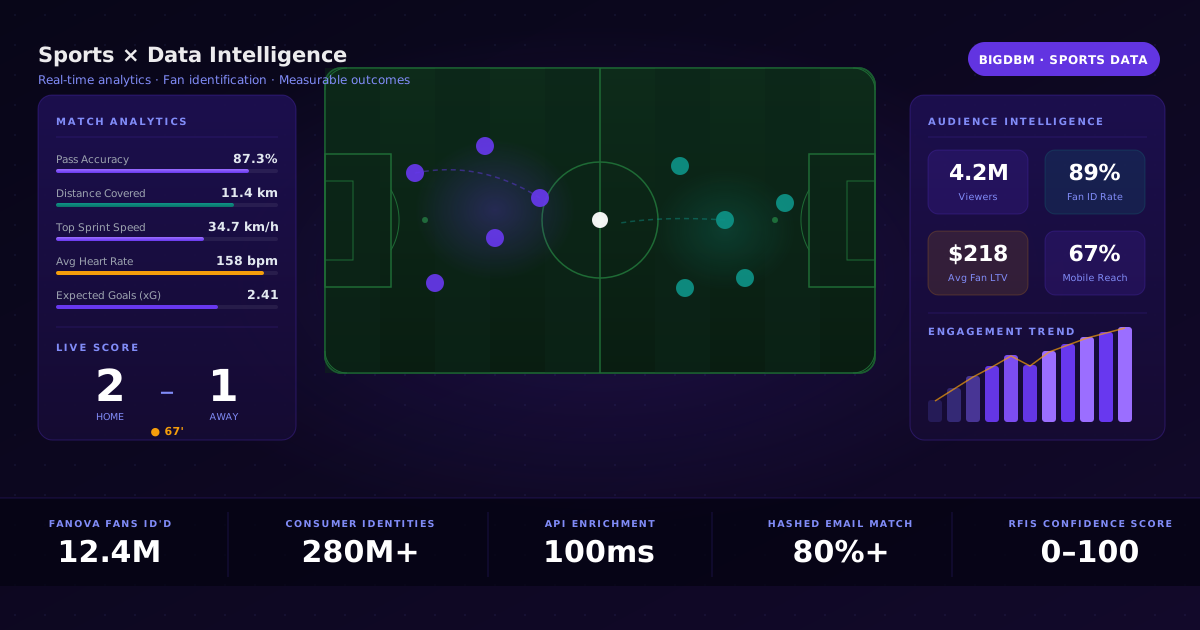
What does that look like in practice? Wearable sensors embedded in kit measure heart rate variability, lactate threshold, GPS-tracked sprint load, and recovery metrics, all in real time. Computer vision systems log every touch, every off-ball run, every pressing trigger from the full squad simultaneously. Expected goals models, possession value frameworks, and TRACAB spatial data have replaced the subjective eye test as the primary language of recruitment and in-game adjustment.
The best teams are not the ones with the most data, they are the ones with the infrastructure to turn raw signals into decisions faster than the competition. Data without interpretation is just noise.
Injury prevention is where the ROI becomes undeniable. Machine learning models trained on years of load data can now flag elevated injury risk 72 hours before a problem manifests clinically. For a franchise paying a star player $30 million a season, preventing a single soft-tissue injury pays for an entire analytics department multiple times over.
And this is no longer exclusive to elite organizations. Cloud-based analytics platforms have made performance intelligence accessible at the college, high school, and recreational levels, compressing the timeline from elite-only technology to democratized tool by roughly a decade.
Fan Identity: The Data Layer Teams Are Still Missing
Performance data gets the headlines. Fan identity data is where the real commercial opportunity lies, and where most sports organizations are significantly under-invested.
The average professional club knows very little about the actual people who fill its stadium, watch its broadcast, and engage with its social channels. It knows seat numbers. It knows transaction histories from the ticketing platform. It knows email addresses, many of which are outdated, mis-formatted, or duplicated across three different CRM systems.
What it often does not know is who those people actually are: their household composition, their income band, their other sports interests, their purchase behavior, their preferred contact channels, or whether they are the kind of fan who buys merchandise once a year or attends every home game.
BIGDBM's FANOVA dataset addresses precisely this gap, first-party fan behavioral data across sports, not inferred demographics. Real behavioral signals tied to real, identified people.
BIGDBM's Sports / FANOVA dataset is built from first-party fan behavioral signals, not probabilistic interest modeling or demographic inference. It connects actual fan behavior to identified individuals, enabling sports organizations, sponsors, and media rights holders to understand their audiences with the kind of resolution that drives meaningful activation decisions.
This matters because sponsorship valuation, broadcast rights negotiations, and merchandise strategies all depend on being able to prove who your audience is, not estimate it. Organizations that can present sponsors with identity-resolved, behaviorally verified fan profiles command a fundamentally different conversation than those presenting panel-based surveys.
The Fan Experience Has Become a Data Product
The sports experience itself has been redesigned around data. Fans do not simply watch games anymore, they participate in a continuous, data-mediated relationship with their teams and athletes across dozens of digital touchpoints.
Mobile apps serve personalized content based on engagement history. Streaming platforms overlay real-time statistics and alternative camera angles. Fantasy leagues and prediction games create active investment in outcomes beyond wins and losses. Social media connects global audiences to moments as they happen, compressing time zones into a single shared experience.
Each of these touchpoints generates signal. And the organizations that have built the infrastructure to capture, resolve, and activate those signals are measurably outperforming those that have not.
- Clubs with identity-resolved fan databases report 40–60% higher merchandise conversion rates from targeted email campaigns
- Broadcast partners with real-time audience intelligence can sell dynamic ad inventory at 2–3× the CPM of standard placements
- Sponsors with access to verified fan identity data consistently report higher return on sports investment than those relying on reach-only metrics
- Fantasy and gaming platforms using intent data to identify in-market users reduce customer acquisition cost by an average of 35%
The infrastructure behind these outcomes is identity resolution at scale, the ability to take a partial signal from any touchpoint (a ticket scan, an app login, an email click, a social engagement) and connect it to a verified individual profile. BIGDBM's identity resolution platform handles exactly this: resolving fragmented fan data from disparate systems into unified, confidence-scored profiles that organizations can actually activate.
Women's Sports: The Most Undervalued Audience in Data
The commercial growth of women's sports over the last three years has been one of the most significant shifts in the industry, and the data confirms it is not a trend but a structural reorientation.
Average attendance at women's soccer, basketball, and volleyball events has grown at a rate that outpaces equivalent men's competitions in most major markets. Television viewership for women's tournaments set records in 2024 and 2025 across multiple sports simultaneously. Sponsorship investment is following, but the analytics infrastructure to support it is lagging behind.
Part of the problem is measurement. Many women's sports properties have historically relied on the same broad audience estimates used across broadcast media, estimates that dramatically undercount the depth of fan engagement because they cannot resolve individual viewers to verified identities.
The organizations moving fastest in this space are those treating women's sports audiences as a first-class data problem: building fan identity graphs, resolving behavioral signals to individuals, and presenting sponsors with verified audience intelligence rather than estimated reach. BIGDBM's sports vertical solutions are designed to support exactly this kind of audience development across all leagues and competition levels.
Mental Wellness as a Performance Metric
The conversation around athlete mental health has shifted from stigma to infrastructure. Elite performance organizations now treat psychological wellness with the same operational rigor applied to physical conditioning, and increasingly, data plays a role here too.
Mood tracking applications, cognitive load monitoring, and sports psychology tools generate signals that, when integrated with physical performance data, produce a more complete picture of athlete readiness. The result is not surveillance, it is a more honest model of human performance that acknowledges the interdependence of mental and physical state.
For sports organizations, the business case is straightforward. Athletes who receive proactive mental health support show lower rates of performance-affecting burnout, faster recovery from setbacks, and longer, more productive careers. For sports data practitioners, it represents an emerging category of signals that will reshape how performance optimization is modeled over the next decade.
What AI and the Next Generation of Tools Will Change
The next wave of sports technology is not incremental, it is architectural. Several developments are converging to redefine what performance intelligence looks like at both the elite and consumer levels.
AI-generated coaching intelligence. Large model systems trained on decades of match footage, biometric data, and outcome records are beginning to generate tactical recommendations that exceed human pattern recognition. These are not replacing coaches, they are giving coaches access to analytical depth that was previously unreachable in the time constraints of a live game.
Virtual and extended reality training. XR environments allow athletes to rehearse high-pressure scenarios, penalty situations, set pieces, defensive transitions, with unlimited repetition and instant feedback. The cognitive load of game situations can now be trained at scale outside of match conditions.
Precision sports medicine. Genomic data, microbiome analysis, and continuous biometric monitoring are enabling recovery and conditioning protocols tailored to individual physiology rather than population averages. Personalized nutrition, individualized training load models, and predictive recovery timelines are moving from research to practice.
Cookieless fan intelligence. As third-party identifiers continue to deprecate, sports organizations face the same challenge as every other media and marketing business: how to maintain audience intelligence without legacy tracking infrastructure. First-party data strategies, identity graph integration, and privacy-compliant enrichment are becoming critical capabilities, not optional upgrades.
BIGDBM's AI Decision Engine applies machine learning models across sports, consumer, and behavioral data to produce confidence-ranked outputs, enabling smarter audience segmentation, better fan acquisition models, and more defensible sponsorship valuation without relying on probabilistic guesswork.
The Competitive Advantage That Compounds
What separates the organizations winning the data game in sports from those watching the gap widen is not budget, it is architecture. The teams and properties that invested early in identity-resolved fan databases, integrated their data sources, and built enrichment workflows are now compounding those advantages with every game, every campaign, and every season.
Each new fan identified, each behavioral signal resolved to a known individual, each campaign outcome linked back to a verified audience segment makes the next decision smarter. Data advantages in sports, as in every industry, are not linear, they are exponential.
The organizations that have not yet made this investment are not simply behind, they are competing with a progressively smaller share of the information their opponents have access to.
Despite all of this, the essence of sports remains unchanged. The moment a goal is scored, a record is broken, or an underdog defies the expected-goals model, those are still human moments that no algorithm produces and no dataset predicts with certainty. Technology does not replace the emotion of competition. It sharpens the organizations built around it.
At BIGDBM, we believe the future of sports belongs to the organizations that treat data not as a reporting tool, but as a competitive infrastructure, one built on accurate identity, first-party behavioral signals, privacy-compliant operations, and the ability to activate intelligence in real time. Whether on the field or in the front office, the teams that win will be the ones who built their data foundation first.