Every agency has had this conversation with a client. The campaign hit its delivery targets, the CPMs looked healthy, and the click-through rate was respectable. Yet the client still asks the question nobody wants to hear: "Why aren't we seeing more sales?"
The answer is usually not the creative or the channel mix. The answer is timing. Most audiences are built on who a person is, while purchase decisions are driven by what a person is doing right now. This guide explains how intent-based audiences close that gap, how to build them responsibly, and how to measure whether they actually work.
Why Traditional Audiences Are Hitting a Ceiling
Lookalike and demographic audiences were built for a world where platforms had deep visibility into user behavior. That world has changed in several ways.
First, signal loss is real. Browser privacy controls, mobile tracking restrictions, and shorter data retention windows mean that platform lookalike models are training on thinner data than they used to.
Second, demographic fit is not the same as purchase readiness. A 42-year-old homeowner with a high household income may be a perfect profile for a kitchen remodel. However, if that person finished a remodel last spring, every impression you serve them is wasted spend.
Third, retargeting pools keep shrinking. Retargeting only reaches people who already found your client. It does nothing for the much larger group of people who are actively researching the category but have never visited the client's website.
The result is that many agencies are optimizing harder and harder inside the same small pool of people. Intent data is one of the most effective ways to expand that pool with people who are genuinely in-market.
What Intent Data Actually Is
Intent data is information that indicates a person or business is actively researching a product, service, or category. It is usually grouped into three types.
First-party intent comes from your client's own properties. Website visits, email engagement, form fills, and CRM activity all fall into this category. It is highly accurate, but it only covers people who already know the brand.
Second-party intent comes from a direct partner who shares their first-party data with you. Publisher partnerships and co-marketing arrangements are common examples.
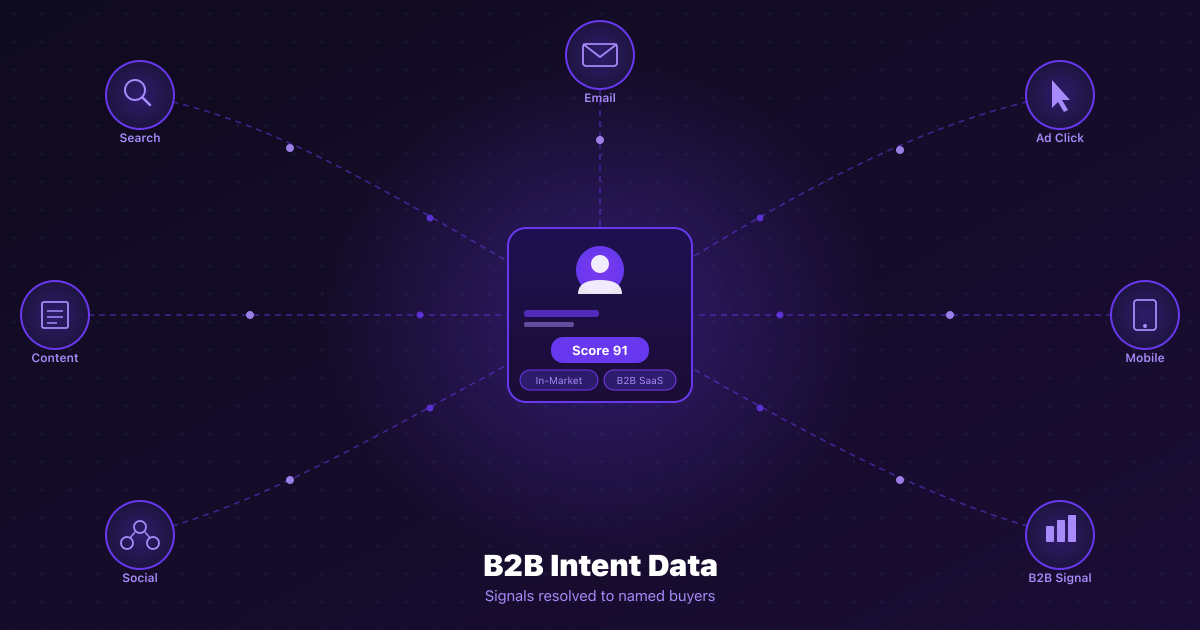
Third-party intent is aggregated from activity across the open web. It captures research behavior such as content consumption, comparison shopping, and category-level searches across many sites. This is the layer that reveals people who are deciding this week but have never interacted with your client.
The most effective audience strategies combine all three. First-party data tells you what a converting customer looks like, and third-party intent tells you who else is behaving that way right now.
The Four Qualities of a Useful Intent Signal
Not all intent data is equally valuable. Before you build an audience around a signal, it helps to evaluate it against four qualities.
- Recency. A signal from yesterday is far more valuable than one from last quarter. Purchase windows in many categories are measured in days or weeks, so freshness matters more than almost anything else.
- Specificity. "Interested in home improvement" is a weak signal. "Researching tankless water heater installation" is a strong one. The narrower the topic, the clearer the buying intent.
- Frequency and depth. One article view may be curiosity. Repeated research across multiple sources over a short window usually indicates a real decision in progress.
- Identity resolution. A signal is only useful if you can connect it to a reachable person or household and activate it in the channels you buy. Without solid identity resolution, intent data stays interesting but unusable.
When you are evaluating any data partner, ask directly how they handle each of these four points. The answers will tell you a lot about how well their audiences will perform.
How to Build an Intent-Based Audience: A Step-by-Step Framework
The following framework works for both B2C and B2B clients, and it can be adapted to almost any vertical.
Step 1: Start With the Client's Best Customers
Pull a sample of recent converting customers from the client's CRM. Look for the common attributes such as geography, household or firmographic traits, and the path they took before converting. This becomes your baseline profile and, later, your measurement benchmark.
Step 2: Map the Research Journey
Ask what a buyer researches before they buy. A prospective solar panel customer might research energy costs, tax incentives, roof condition, and installer reviews. A B2B software buyer might research competitor comparisons, integration guides, and pricing models. Each of these topics becomes a potential intent signal.
Step 3: Layer Intent on Top of Fit
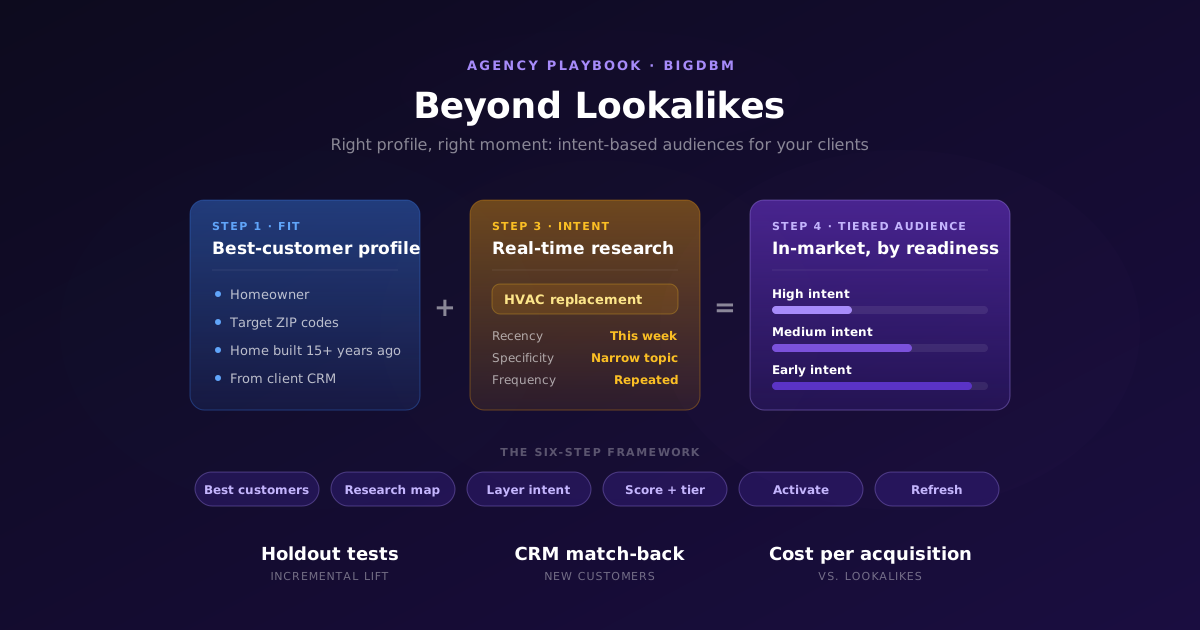
The strongest audiences sit at the intersection of right profile and right moment. Start with your fit criteria from Step 1, and then filter for people showing active research behavior from Step 2. This is where an audience creation platform does the heavy lifting.
For example, BIGDBM's Audience Creation platform lets agencies combine consumer attributes, property data, and real-time intent signals in a single build. You might filter for homeowners in specific ZIP codes, whose homes are older than 15 years, who have shown recent intent around HVAC replacement. Each of those layers on its own is useful, but the combination is what produces an audience that converts.
The strongest audiences sit at the intersection of right profile and right moment. Fit tells you who could buy. Intent tells you who is buying now.
Step 4: Score and Tier the Audience
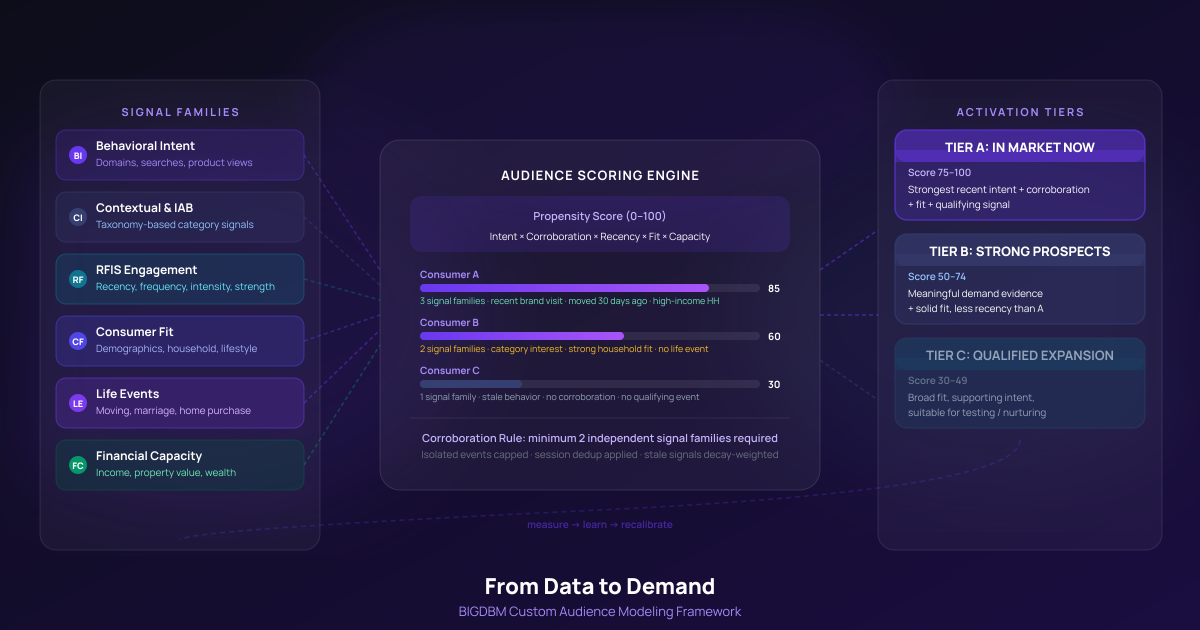
Not every in-market person is equally ready. Tier the audience by signal strength so you can match spend and messaging to readiness.
- High intent: recent, specific, repeated signals. These people deserve your strongest offers and highest bids.
- Medium intent: relevant signals with lower frequency. These people respond well to educational and comparison content.
- Early intent: broad category interest. These people are good candidates for awareness and nurture sequences.
Step 5: Activate in the Channels You Already Buy
An audience only creates value once it reaches a channel. Make sure your data can be delivered to the DSPs, social platforms, CTV partners, direct mail vendors, and email platforms you already use for the client. Speed matters here as well, because an intent signal loses value with every day it sits unused. Ideally, you want to go from audience build to activation on the same day.
Step 6: Refresh Continuously
Intent audiences are not "build once and forget." People move in and out of market constantly. Set a refresh cadence that matches your client's purchase cycle, which is often weekly for consumer categories and every two to four weeks for longer B2B cycles.
Measuring Whether It Works
Clients are rightly skeptical of new data sources, so measurement should be designed in from the start rather than added at the end. Here are four approaches that agencies use to prove impact.
Holdout testing. Withhold a randomly selected portion of the intent audience from exposure, and compare conversion rates between the exposed group and the holdout group. This is the cleanest way to show true incremental lift.
Head-to-head audience tests. Run the same creative and budget against a standard lookalike audience and an intent-based audience. Compare cost per acquisition, not just click-through rate.
CRM match-back. After the campaign, match converting customers in the client's CRM back to the audience file. This shows how many new customers came from the intent audience and how quickly they converted. If match rates come back lower than expected, our guide on auditing match rates walks through what to check.
Pipeline velocity for B2B. For business clients, track how quickly intent-sourced leads move through pipeline stages compared with leads from other sources.
When you present results, lead with business outcomes such as cost per acquisition, revenue, and pipeline. Engagement metrics are helpful supporting evidence, but they rarely win a renewal on their own.
The Second Use Case: Finding Your Agency's Next Client
Most agencies think about intent data only in terms of client campaigns. However, the same approach works for your own new business development.
Brands that are about to hire an agency leave signals too. They research agency services, read about category trends, compare vendors, and explore new channels. B2B intent data can surface companies in your target verticals that are showing exactly this kind of behavior.
This changes the new business process in a meaningful way. Instead of cold outreach to a static list of target accounts, your team can prioritize the brands that are already evaluating options. BIGDBM's business data and intent signals are designed to support both sides of this equation, so the same dataset that powers client campaigns can also help you decide which prospects to call first.
Privacy and Compliance: Non-Negotiables
Intent data is only an asset if it is collected and used responsibly. Before you work with any data partner, confirm the following points.
- The data is sourced with appropriate consent and complies with applicable U.S. federal and state privacy laws.
- Sensitive categories, such as health conditions and other protected characteristics, are handled according to platform policies and legal requirements.
- The partner can explain their data sourcing clearly and provide documentation when your clients ask for it.
- Opt-out requests are honored and propagated across audience files.
Clients increasingly ask agencies about data provenance during procurement. Having clear answers ready builds trust and often shortens the sales cycle. Our CCPA compliance checklist is a useful starting point.
A Quick Checklist for Your Next Campaign
Use this checklist the next time you plan an audience strategy for a client.
- Have we defined the client's best-customer profile from real CRM data?
- Have we mapped the research topics that precede a purchase in this category?
- Are we layering intent signals on top of demographic or firmographic fit?
- Have we tiered the audience by signal strength?
- Can we activate the audience in our existing channels on the same day?
- Is there a refresh cadence that matches the purchase cycle?
- Have we designed a holdout test or match-back before launch?
- Can we document the privacy compliance of every data source we use?
Final Thoughts
The agencies that will stand out over the next few years are not necessarily the ones with the largest media budgets. They are the ones that know who is buying before the ad runs. Intent-based audiences give agencies a practical way to spend less on people who are not in-market, prove ROI with cleaner measurement, and find new clients at the moment those brands are looking.
See an intent-based audience for your ideal client
The BIGDBM team can put together an audience preview built around your agency's ideal client profile that you can compare directly against your CRM. It is an easy way to test the approach before committing to anything.