At some point, every data team runs into the same conversation: the current setup is creaking under the load and it's time to pick a platform that can actually scale. The options have never been better, which paradoxically makes the decision harder. EMR, Snowflake, Databricks, BigQuery, Redshift: each has a vocal fanbase, a compelling benchmark story, and a pricing model that looks attractive until you're actually running it at production volume.
At BIGDBM, processing identity data across 280 million consumer records, 700 million email addresses, and billions of device linkages is a daily operational reality. We have opinions about what these platforms are genuinely good at and where they quietly fail you. This guide is the comparison we wish we'd had before making some of our own choices.
The short version: no single platform wins across all workloads. The teams that get this right pick tools based on workload type, not vendor prestige. The teams that struggle pick one platform and force everything through it because the budget or the politics made consolidation feel safer than it was.
What "Scale" Actually Means
Before comparing platforms, it helps to be precise about what you're scaling. These are different problems that favor different architectures:
- Data volume scale: processing files that are terabytes or petabytes, joining datasets with billions of rows, running ETL pipelines that touch every record in your lake
- Concurrency scale: hundreds of analysts running ad-hoc queries simultaneously against the same warehouse without stepping on each other
- Compute-intensive scale: training ML models, computing confidence scores across hundreds of millions of records, running graph algorithms over identity networks
- Latency scale: serving enrichment results in under 500ms via API, processing streaming events within seconds of ingestion
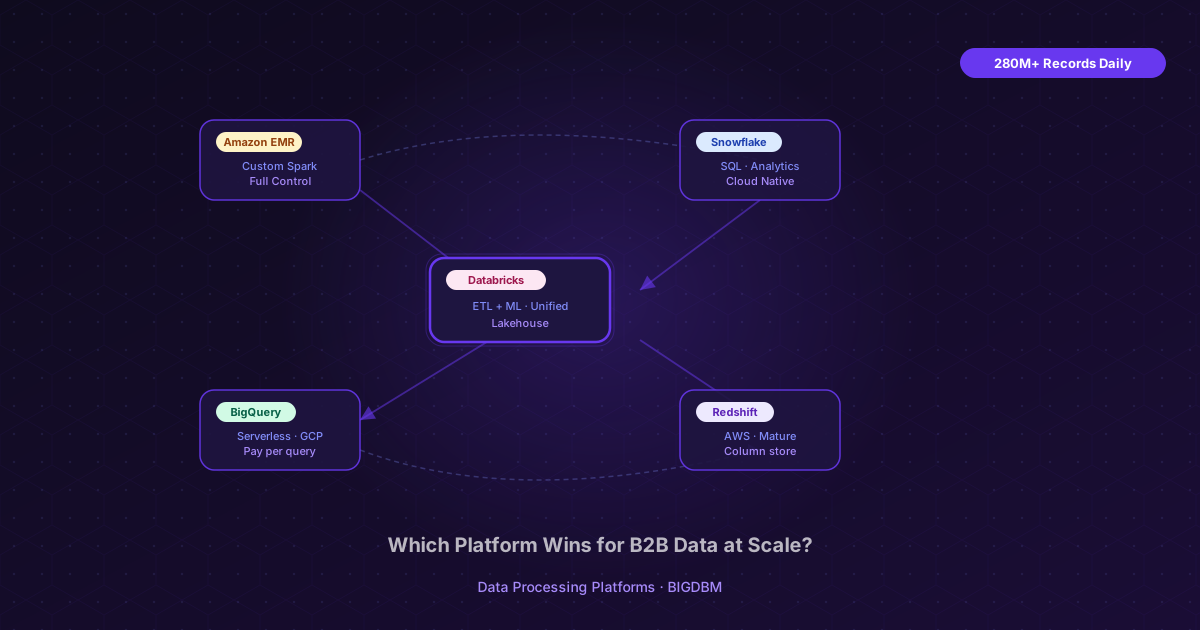
Each platform has a different sweet spot. EMR is built for the first and third. Snowflake is built for the second. Databricks tries to handle all four and largely succeeds, at a price. BigQuery is exceptional for the second and surprisingly good at the first if you're on GCP. The mistake is assuming "scale" is one thing and then optimizing for the wrong dimension.
Amazon EMR
Elastic MapReduce
EMR is AWS's managed cluster service for running Apache Spark, Hive, Presto, Flink, and the broader Hadoop ecosystem on EC2 or EKS. It's the oldest of the major options and carries the reputation of being complex to operate, which is partly earned and partly outdated. EMR Serverless, launched in 2022, eliminated the most painful parts of cluster management and brought it much closer to the simplicity of Glue or Databricks Jobs.
The core value proposition is control. You can run any JVM, Python, or Scala code you want against any data format on S3. There's no abstraction layer between you and the compute. For teams doing heavy ETL, custom identity resolution logic, or ML training at scale, that flexibility matters. You're not working within a vendor's opinionated framework. You're running Spark directly.
Strengths
- Full Spark ecosystem access, no restrictions
- Cheapest option per compute unit at large scale
- Works natively with S3 and the AWS data stack
- EMR Serverless removes cluster management overhead
- Handles unstructured data and custom file formats
- Good for long-running batch jobs with predictable resource needs
Weaknesses
- Spark tuning is still required for complex jobs
- No native SQL analytics UI; analysts need Athena or another layer
- Slower iteration cycle than notebook-first platforms
- Debugging failed jobs is harder than on Databricks
- No built-in ML experiment tracking or feature store
- Cold start latency on serverless can be 2-4 minutes
Best for: large-scale batch ETL, custom processing logic, cost-sensitive workloads at volume, teams already deep in the AWS ecosystem
Snowflake
Cloud Data Warehouse
Snowflake's architecture breakthrough was separating storage from compute, which sounds obvious in retrospect but solved a real problem: you no longer had to size a cluster for peak concurrency and pay for that capacity at 3am when nobody's running queries. Virtual warehouses scale independently, multiple workloads share the same data without contention, and the whole thing runs on whatever cloud provider you're already using.
For analytical workloads, Snowflake is genuinely excellent. SQL is the primary interface, which means your entire analytics and BI team can use it without learning Spark or Python. Performance on large aggregations is fast, time travel and zero-copy cloning make data versioning and development environments much cleaner, and Snowflake's data sharing capabilities are uniquely strong for organizations that need to exchange data with partners without physically moving files.
Strengths
- Best-in-class concurrency, no query queuing problems
- SQL-first, immediately accessible to analysts
- Zero-copy cloning and time travel for dev environments
- Data sharing across organizations without ETL
- Automatic scaling, minimal operational overhead
- Strong ecosystem of dbt, Fivetran, Looker integrations
Weaknesses
- Expensive at high compute volume (credits add up fast)
- Not designed for Python/ML-heavy workflows natively
- Snowpark (Python) is improving but still not Databricks territory
- Full table scans on multi-terabyte tables can be slow and costly
- Vendor lock-in: data stored in Snowflake's internal format
- Not the right choice for streaming or sub-second latency requirements
Best for: analytics and BI, concurrent analyst workloads, data sharing with external partners, SQL-first teams, dbt-based transformation pipelines
Databricks
Unified Analytics Platform
Databricks was built by the team that created Apache Spark, and it shows. The platform is purpose-built for the team that wants one place to do data engineering, machine learning, and analytics rather than stitching three separate tools together. Delta Lake, their open table format, brings ACID transactions and schema enforcement to the data lake, which was genuinely missing from raw S3-based Spark workflows. The Photon engine accelerates SQL workloads to compete with Snowflake on analytical query performance.
The unified notebook environment is where Databricks earns its price premium for the right teams. Data engineers and data scientists working in the same repository, on the same data, with MLflow tracking experiments, Feature Store managing shared features, and Delta Live Tables automating pipeline orchestration. That kind of integrated workflow is hard to replicate with separate tools. If your team spans data engineering and ML, the operational reduction from not context-switching between platforms is real and measurable.
Strengths
- Best platform for teams combining ETL and ML in one workflow
- Delta Lake brings ACID reliability to the data lakehouse
- MLflow, Feature Store, and Unity Catalog are genuinely mature
- Photon engine makes SQL performance competitive with Snowflake
- Delta Live Tables simplifies pipeline orchestration significantly
- Open formats: data is in Parquet/Delta, not proprietary storage
Weaknesses
- More expensive than raw EMR for equivalent Spark workloads
- Cluster startup time still 3-5 minutes for non-serverless compute
- SQL analytics UX is improving but still not as polished as Snowflake for pure BI
- Steeper learning curve for analysts who only know SQL
- Pricing model complexity makes cost forecasting difficult
- Overkill for teams with no ML use cases
Best for: teams that blend data engineering and ML, large-scale feature computation, streaming and batch in one platform, organizations that want open data formats
Google BigQuery
Serverless Analytics
BigQuery's bet was serverless from the start, before serverless was a buzzword. You don't manage clusters, you don't size warehouses, you just run SQL and it returns results. For ad-hoc analytics at massive scale, nothing is faster to get started with or easier to operate. Scanning a terabyte of data in seconds with no infrastructure setup is a genuine capability that most other platforms can't match without configuration work.
The on-demand pricing model (you pay per terabyte of data scanned) is a double-edged sword. For exploratory analytics it's wonderfully cheap. For production workloads with predictable query patterns, flat-rate pricing is usually more economical, but it requires estimating your slot consumption accurately. Teams that move to BigQuery from a fixed-cost warehouse and don't configure appropriate query controls can receive a surprising bill at the end of the first month.
Strengths
- Truly serverless, zero infrastructure management
- Extremely fast on columnar scan workloads
- BigQuery ML for SQL-based model training without data movement
- Native integration with GCP ecosystem and Looker
- Strong storage pricing for large, infrequently queried datasets
- Omni for cross-cloud query across AWS and Azure data
Weaknesses
- On-demand pricing can surprise teams without query cost controls
- Deeply tied to GCP, so cross-cloud flexibility is limited in practice
- Not a natural choice for heavy ETL or custom Spark code
- Less mature ecosystem than Snowflake for dbt/BI tooling
- Row-level operations and small frequent writes are not its strength
- Limited for streaming compared to Dataflow or Flink
Best for: GCP-native teams, ad-hoc analytics at scale, organizations that want zero infrastructure overhead, SQL-first teams doing large data scans
Amazon Redshift
AWS Data Warehouse
Redshift was the first cloud data warehouse that made columnar analytics accessible at scale, and it still has a large installed base in AWS-native organizations. Redshift Serverless addressed the biggest operational complaint (cluster sizing and management), and Redshift Spectrum lets you query S3 data directly without loading it into Redshift first, which reduces data duplication significantly. For organizations already running on AWS with existing Redshift investments, the switching cost to Snowflake or Databricks is real and needs to be justified by actual workload performance gains.
The honest assessment is that Redshift lost ground to Snowflake on the concurrency and ease-of-use dimensions and to Databricks on the ML/engineering dimension. It remains a solid choice for AWS-native teams with SQL-first workloads and existing Redshift expertise, but if you're starting from scratch in 2026 and your primary workload is analytics, Snowflake is usually the more future-proof choice on AWS.
Strengths
- Deep AWS ecosystem integration (Glue, Lambda, S3, SageMaker)
- Redshift Serverless simplifies operations significantly
- Spectrum for querying S3 without data loading
- Mature product with large knowledge base
- Competitive on cost for predictable, steady-state workloads
Weaknesses
- Concurrency and scaling not as seamless as Snowflake
- VACUUM and ANALYZE maintenance still required on older tables
- Less momentum and ecosystem innovation than Snowflake or Databricks
- Not the right choice if your team needs Python/ML capabilities
- Migration from provisioned to Serverless is not always seamless
Best for: existing AWS/Redshift organizations, SQL-first analytics, teams already invested in the AWS data stack who don't need ML workflows
The Platforms Nobody Talks About (But Should)
The five platforms above get most of the comparison content, but a few others deserve mention depending on your architecture.
Apache Flink is the right answer when your problem is real-time stream processing at high throughput. Spark Streaming works for micro-batch, but if you need true event-time processing with sub-second latency and exactly-once semantics, Flink is architecturally superior. Managed Flink on AWS (formerly Kinesis Data Analytics) removed most of the operational overhead. For identity resolution pipelines that need to process incoming device signals and update match scores in near real-time, Flink handles it cleanly where Spark Streaming would introduce latency.
Trino (formerly PrestoSQL) is the federated query layer that lets you run a single SQL query across data sitting in S3, a Postgres database, Hive, Kafka, and Snowflake simultaneously. It doesn't store data; it's purely a compute layer. For organizations with data spread across multiple systems that aren't ready to centralize, Trino is the pragmatic bridge. Starburst and Amazon Athena are both managed Trino distributions.
dbt (data build tool) deserves mention even though it's not a processing engine. dbt is the transformation layer that runs on top of Snowflake, Databricks, BigQuery, or Redshift and turns raw data into analytics-ready tables using SQL. It handles dependency management, testing, documentation, and lineage. In 2026, running Snowflake or BigQuery without dbt is like running a React app without TypeScript: technically possible but leaving significant reliability tooling on the table.
What Actually Breaks at Billion-Row Scale
The benchmark comparisons rarely tell you what actually goes wrong when you're processing 500 million records daily in production. These are the failure modes we've hit, and they apply regardless of which platform you're running on.
Data skew in distributed joins. When one key appears disproportionately often in a join, one executor gets most of the work and the job stalls. This is a Spark problem on EMR and Databricks equally. The fix is salting the keys before the join, which is unintuitive if you haven't seen it before and obvious in retrospect once you understand what's happening in the shuffle.
Runaway query costs on Snowflake. A single analyst with a poorly-written query that does a full scan of a multi-terabyte table and forgets to apply the partition filter can generate a meaningful percentage of your monthly Snowflake bill in one execution. Query cost controls, warehouse timeouts, and resource monitors are not optional in production. They're infrastructure.
Schema evolution breaking downstream pipelines. Adding a column to an upstream table shouldn't break anything. In practice it breaks SELECT * queries, dbt models that assumed a fixed schema, and Spark jobs that serialized the schema at job submission rather than at runtime. Delta Lake's schema evolution handling and dbt's explicit column definitions both address this, but only if you've set them up deliberately.
Small file problems on S3. A Spark job that writes one output file per partition produces thousands of tiny Parquet files in S3. Reading those back in a future job is dramatically slower than reading the same data in a few large files because of the S3 request overhead per file. Compaction jobs that merge small files are a maintenance task that most teams add late, after noticing degrading read performance over time.
Cold start latency for API-serving workloads. EMR Serverless, Databricks serverless compute, and even Snowflake virtual warehouses have warm-up periods that make them unsuitable for sub-second API response requirements. If you need to enrich records in real time via API (BIGDBM's enrichment APIs return in 100-300ms), you're not serving those responses from a cold data warehouse query. You need a pre-materialized serving layer, typically something like DynamoDB or Redis, fed by your batch processing pipeline and indexed for point lookups.
How BIGDBM Thinks About This
Processing identity data at scale means running different workload types that genuinely favor different tools. Forcing everything through one platform would mean either overpaying for Databricks compute on simple SQL reporting or under-serving the ML scoring workloads that need Python and distributed compute.
Batch enrichment pipelines that join incoming files against the identity graph at hundreds of millions of records run on Spark, taking advantage of the full ecosystem without the cost overhead of a higher-level platform for jobs that are well-understood and stable. Analytics, reporting, and the data access layer that supports the Intelligence Marketplace runs on a SQL-accessible warehouse layer where analysts and product can run queries without writing Spark code. RFIS confidence scoring, which involves computing multi-dimensional confidence signals across every record in the dataset, uses a distributed compute environment that can run Python and handle the kind of iterative graph traversal that SQL alone doesn't express cleanly.
The Real-Time Enrichment APIs serve results in 100-300ms by reading from a pre-materialized index, not from a live query against the data lake. The batch processing pipeline keeps that index current; the serving layer just handles the point lookups. Conflating the two would mean either slow APIs or expensive always-on warehouse compute, and neither is acceptable at production scale.
The right question is not "which platform should we standardize on?" It's "which workloads do we actually have, and what does each one need?" Most mature data teams end up with two or three platforms, each handling the workloads it's actually built for.
A Decision Framework
Start here: what is your primary workload?
The Platform Comparison Matrix
| Capability | EMR | Snowflake | Databricks | BigQuery | Redshift |
|---|---|---|---|---|---|
| Batch ETL at scale | Excellent | Good | Excellent | Good | Good |
| Concurrent SQL analytics | Poor | Excellent | Good | Excellent | Good |
| ML / model training | Good | Poor | Excellent | Good | Poor |
| Streaming / real-time | Good | Poor | Good | Limited | Poor |
| Operational simplicity | Moderate | Excellent | Good | Excellent | Good |
| Cost at high volume | Low | High | Moderate | Moderate | Moderate |
| Python ecosystem access | Full | Limited | Full | Limited | Poor |
| Open data formats | Yes | No | Yes (Delta) | No | No |
| Data sharing with partners | Poor | Excellent | Good | Good | Poor |
Platform choices made in 2026 tend to stick for three to five years because of the migration costs once pipelines, transformations, and team skills are built around a specific tool. Getting the choice right, or at least consciously wrong in a way you can fix later, is worth the upfront analysis time. The teams that struggle are usually the ones who picked the platform with the best marketing at the time rather than the one that matched their actual workload distribution.