Here is a hypothetical example, not a real customer. Imagine a shopper named Dana. On Monday she gets a promotional email about a sofa sale. On Tuesday a connected TV ad for the same sale plays during a show she's watching. On Wednesday the ad shows up in her social feed. On Friday a postcard arrives in her mailbox.
From Dana's side, that is four reminders about one sale. From the marketing side, it is four separate programs, each run in its own tool, each convinced it is introducing the brand to someone new.
None of those teams did anything wrong. Each one followed the process its own platform expected. The problem sits underneath the channels, and it is a problem of identity. This post explains why it happens and what it takes to fix it.
Every channel keeps its own list of people
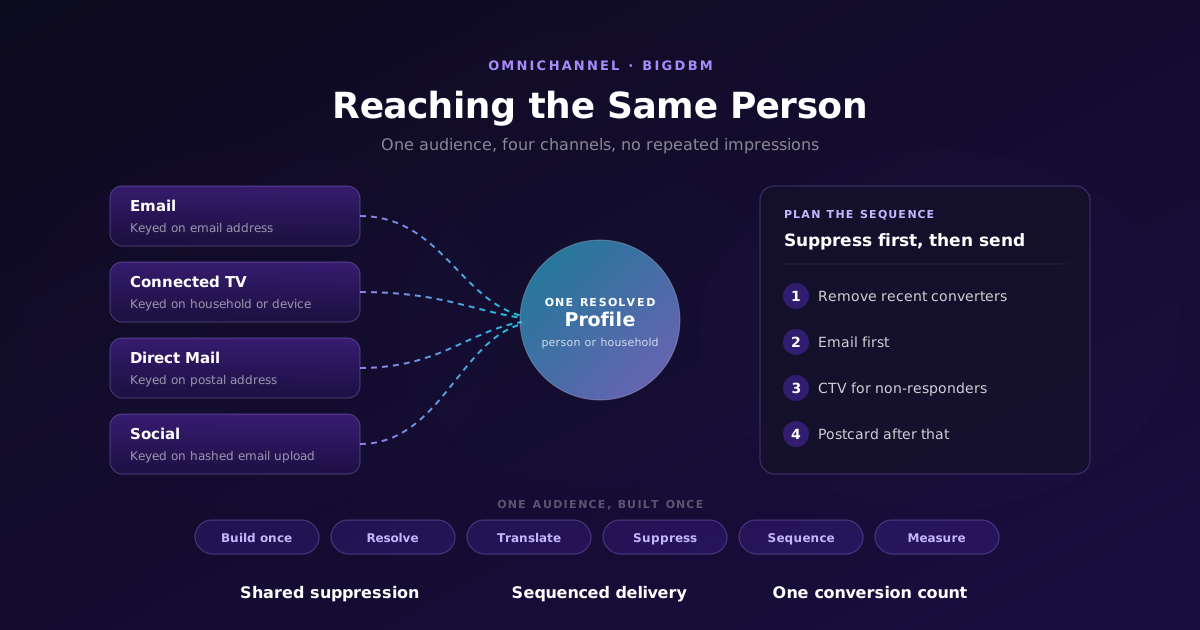
Each channel recognizes people by a different identifier:
- Email works from an email address.
- Direct mail works from a postal address.
- Connected TV commonly works from a household, using an IP address or a device identifier.
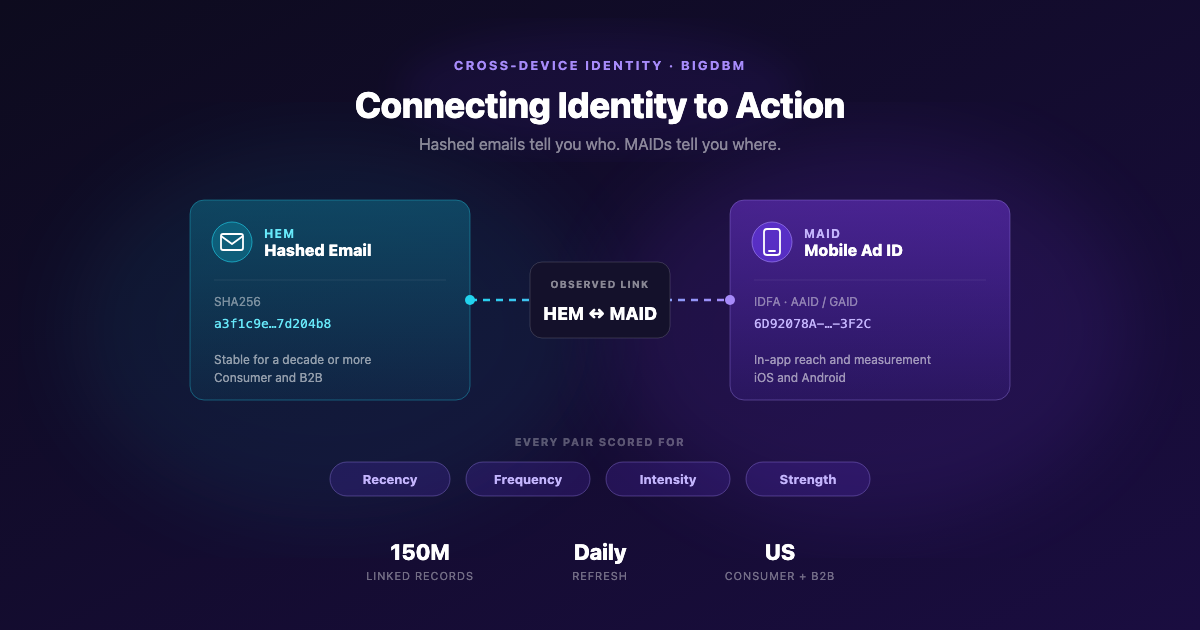
- Social platforms work from their own user accounts, which brands usually reach by uploading a hashed email address or phone number.
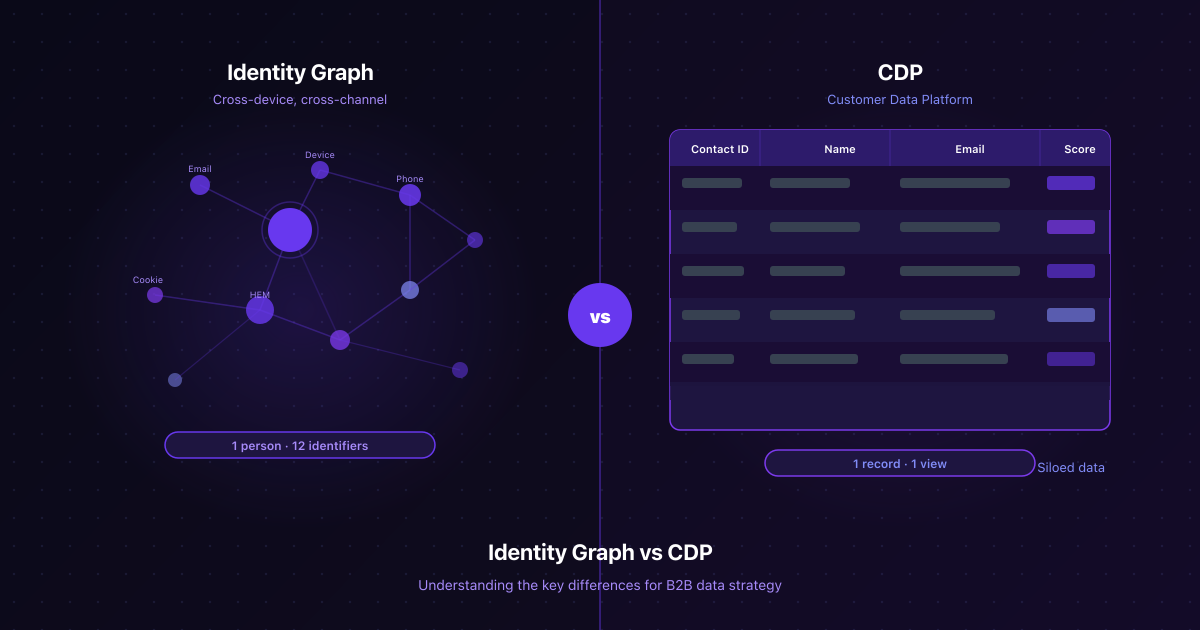
Those identifiers don't naturally connect to each other. Dana's email address, her home address, her streaming device, and her social account are four different records, and no channel knows that they describe one person. When a brand builds an audience separately in each tool, it ends up with four lists that overlap in ways nobody can see.
What goes wrong when the lists don't connect
Most of the symptoms look like ordinary marketing problems, which is why the cause is easy to miss.
People get too much of the same message. Frequency caps are usually set inside a single channel. A cap on CTV ads typically doesn't account for the emails and social ads going to the same person that week.
Money goes to people who already converted. If Dana buys the sofa on Tuesday, the email platform may learn that quickly. The postcard that was already printed, and the social campaign that runs on a different refresh schedule, may not.
Messages drift apart. Separate teams write separate copy. One channel may still promote an offer that another channel has already replaced, and the customer sees the mismatch.
Results get counted twice. When each platform reports its own conversions, the same sale can be credited to several channels at once. The totals look better than the business results actually are.
What identity resolution does about it
Identity resolution connects the different identifiers that belong to the same person or household, so they can be treated as one record instead of many.
In practice, that means a resolved profile might link an email address, a phone number, a postal address, a hashed email, and a set of device identifiers. The link is the useful part. Once Dana's identifiers are tied together, a decision made about Dana can travel to every channel.
There are two things worth knowing about how those links get made.
First, links vary in strength. Some are very certain, such as an email address that appears alongside a postal address in a trusted record. Others are inferred and less certain. Good identity systems record that difference as a confidence score, so a team can decide how strict to be. A loose match might be fine for a general awareness campaign, while a strict one makes more sense when a mistake is costly.
Second, the unit matters. A person and a household are not the same thing. A direct mail piece lands at a household, and a CTV ad often reaches a household as well, while an email or a social ad reaches one individual. A brand should decide up front whether it is counting people or households, and apply that choice consistently.
How one audience runs across four channels
With identities connected, the workflow changes. The order below is a simplified version of what a team would do.
- Build the audience once. Define who you want to reach, such as recent site visitors, past customers who haven't purchased in a year, or people showing interest in a product category. This definition lives in one place instead of four.
- Resolve it to people. Each member of the audience is matched to a resolved profile, which gives the team a single record to work from.
- Translate it for each channel. The same audience is delivered in whatever form each channel needs: email addresses for email, postal addresses for direct mail, device or household identifiers for CTV, and hashed identifiers for social upload.
- Apply suppression before anything goes out. Existing customers, recent converters, and anyone who has opted out are removed from the audience centrally, so the removal applies everywhere at once.
- Plan the sequence, not just the channels. Because one person is one record, a team can plan an order, such as email first, CTV for people who haven't responded, and a postcard after that. Without a shared identity, that kind of sequencing is guesswork.
- Measure against the same people. Results are tied back to the resolved profile, so a conversion is counted once and credited with the full picture of what the person saw.
Things to get right
This approach isn't automatic, and a few details decide whether it works well.
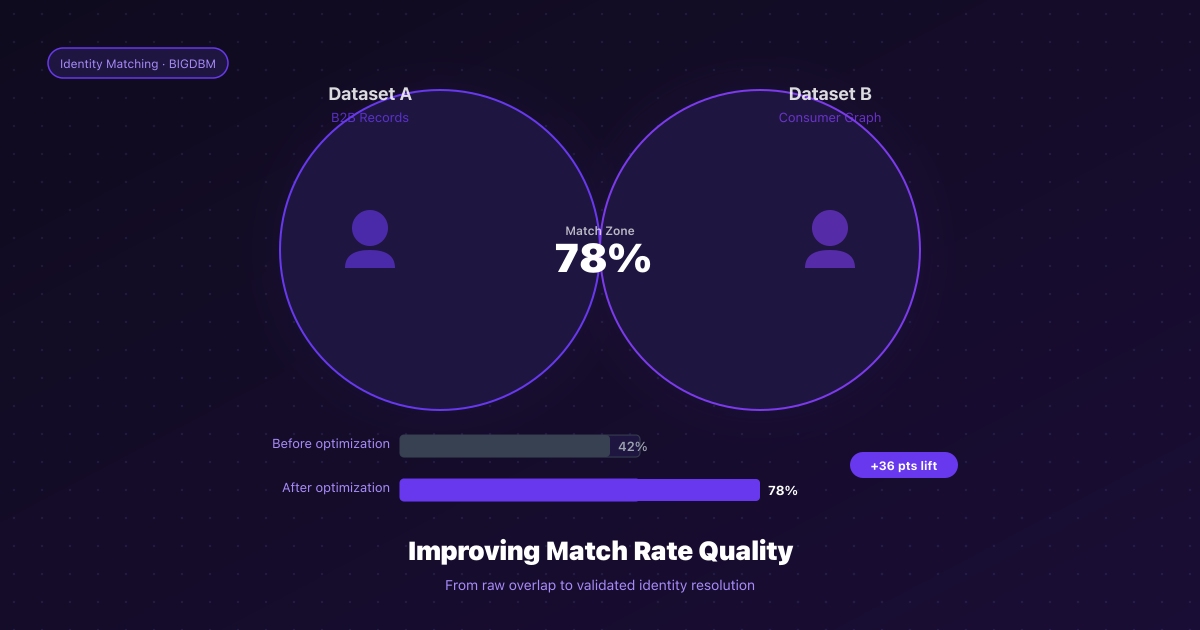
Match rates differ by channel. Not every identifier will resolve in every channel. A person may match for email and direct mail but not for CTV. Expect uneven coverage, and measure it per channel instead of assuming one number applies everywhere. Our post on auditing your match rates covers how to check this.
Data goes stale. People move, change email addresses, and switch devices. An identity link that was accurate last year may not be accurate now, so ask how often the underlying data is refreshed.
Consent travels with the person. If someone opts out in one channel, that choice should be honored in all of them. This is one of the practical benefits of a shared identity, and it only works if opt-outs are actually fed back into the system. Marketers should also confirm which uses of the data are permitted for each audience.
Suppression has a delay. Even with a connected identity, a purchase takes time to reach every platform. Build in a short buffer, especially for direct mail, where printing happens well before delivery.
A simple place to start
Teams don't have to connect everything at once. A reasonable first step is to take one audience you already run in two channels, such as email and social, and check how many people appear in both. That overlap number shows how much repeated exposure may be happening. From there, add suppression across both channels, and then bring in a third.
Where BIGDBM fits
BIGDBM maintains an identity graph that links identifiers across digital and offline channels, including email, phone, physical address, hashed email, and mobile advertising IDs. Its Customer Engagement Platform is a managed service for campaigns across email, SMS, display, connected TV, social, and direct mail. If you're comparing options, the questions above are a useful checklist whichever provider you choose.
The goal is a simple one. Dana should hear from a brand that seems to know what it has already told her.
See one audience across your channels
The BIGDBM team can show how identity resolution and the Customer Engagement Platform run one audience across email, CTV, direct mail, and social, with suppression applied before anything goes out.