Artificial intelligence is evolving beyond generating content and answering questions. AI agents are being used to analyze information, make recommendations, and execute tasks. But their effectiveness depends on the quality of the data they can access.
At BIGDBM, we combine consumer identity expertise, data enrichment, and technology to help organizations build the trusted data foundation needed to realize the potential of agentic AI.
Start With a Trusted View of the Consumer
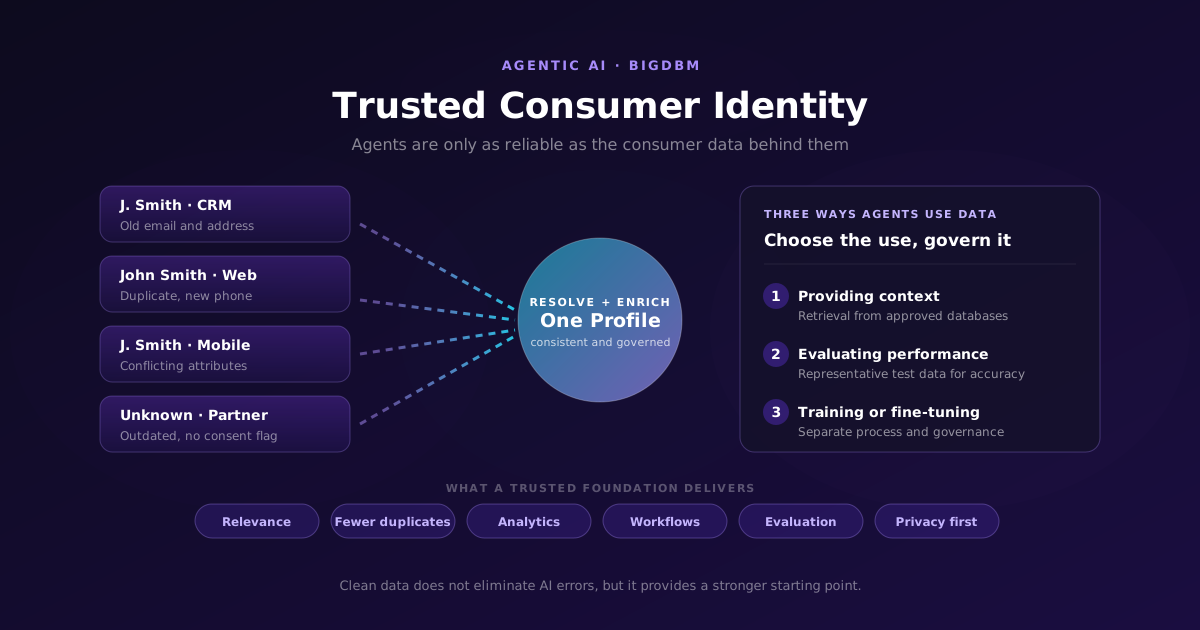
Consumer information is often spread across databases, systems, and customer touchpoints. Records may contain inconsistent identifiers, incomplete demographic details, outdated attributes, or duplicates representing the same individual.
Consumer identity resolution determines which records are likely to belong to the same person. Identity management processes help maintain consistency, while data enrichment adds relevant information to improve the completeness and usefulness of consumer records.
BIGDBM combines comprehensive consumer data with identity resolution and enrichment capabilities to create a more complete and reliable view of consumers. This foundation helps organizations improve marketing effectiveness, strengthen analytics, and support AI-driven applications that enhance customer experiences and operational efficiency.
The goal is not simply to collect more information. It is to make it more reliable, connected, and useful.
Why Data Quality Matters for AI Agents
AI agents rely on information to understand context and determine appropriate next steps. When data contains conflicting identities, inaccurate attributes, or outdated information, an agent may generate irrelevant recommendations or act on an incomplete picture.
A trusted consumer data foundation:
- Improves relevance: Provides richer consumer context to inform more personalized marketing recommendations and business strategies, helping businesses improve engagement, increase conversions, and strengthen customer relationships.
- Reduces fragmentation: Reconciles duplicate or disconnected records to create a more consistent view of consumers, reducing inefficiencies, improving targeting, and delivering a more cohesive customer experience.
- Strengthens analytics: Supports deeper audience insights, more accurate campaign measurement, and data-driven decision-making, helping businesses optimize marketing investments and improve performance.
- Enables better workflows: Provides AI agents with reliable consumer information to support automated workflows and more informed decisions, reducing manual effort and improving operational efficiency.
- Improves evaluation: Provides high-quality reference data to test and validate AI agent accuracy and relevance, helping businesses identify performance gaps, reduce errors, and build confidence in AI-driven decisions.
Consider an AI agent helping a marketing team determine the next best engagement for a consumer. If identity records are inconsistent, the agent may treat one person as multiple consumers or incorrectly combine information belonging to different people. Reliable identity resolution and appropriately governed enrichment can reduce these risks, improve targeting accuracy, and support more relevant customer interactions.
Clean data does not eliminate AI errors, but it provides a stronger starting point.
From Consumer Data to Agentic AI
It is important to distinguish between using data to provide context, evaluate AI performance, and train models.
- Providing context: AI agents can retrieve relevant information from approved databases when completing tasks. Retrieval-augmented generation (RAG) enables models to use external information without retraining the model itself.
- Evaluating performance: Representative test data helps organizations assess whether agents produce accurate, consistent, and appropriate results.
- Training or fine-tuning: Carefully selected and prepared data can be used to train models or adapt them to specific tasks. This requires separate technical processes and governance.
Consumer identity data can support these approaches, depending on the use case, technical design, and permitted data uses. In every case, data quality and appropriate controls matter.
Privacy and Trust Must Come First
Using consumer information responsibly is essential. Privacy, security, consent, permitted use, data minimization, and access controls must be central to AI initiatives involving personal information.
Organizations must also account for incorrect identity matches, outdated attributes, and potential bias. Human oversight and ongoing performance monitoring remain important when AI-generated recommendations may affect consumers.
At BIGDBM, we recognize that advancing data capabilities must go hand in hand with responsible data practices, privacy, and security.
Preparing for the Future
Organizations can prepare for agentic AI by strengthening identity resolution, improving data quality, defining approved data uses, establishing access controls, and testing focused use cases against measurable business outcomes.
The opportunity goes beyond adopting another AI tool. It is about building the trusted data foundation that helps technology solve real business problems.
As agentic AI evolves, organizations that invest in connected, reliable, and responsibly managed consumer data will be better positioned to realize its potential. At BIGDBM, we help organizations put that foundation to work through consumer identity resolution, comprehensive data, and enrichment capabilities that support smarter decisions, better customer experiences, and improved business outcomes.
Build a stronger foundation for AI-driven applications
Learn how BIGDBM's consumer identity resolution and data enrichment solutions can help your organization build a stronger foundation for AI-driven applications.